Built around the Stop-Loss Principle

Open Interest (OI) Analysis Tool for Options Trading

Best Open Interest (OI) Analysis Tool for Options Trading - India’s Ultimate OI Analysis tool with accurate OI data. Predict market direction across Nifty, Banknifty, FinNifty Indices and all 191 FNO stocks with OI Analysis, Multi-Strike OI, Option Chain and more.

No credit card required  ·  Trial Plan available  ·  Setup in 3 minutes

Open Interest (OI) Analysis Tool for Options Trading
58K+
Active Traders
195+
NSE Instruments Tracked
58+
Expiry OI Charts
3 min
Avg Setup Time

Most Retail Traders Are Flying Blind on OI

You check the price. You check the volume. But price and volume only show you what happened — not what's about to happen. Open Interest is the one metric that reveals where smart money is positioned right now.

No Context on OI Data

Raw OI numbers without interpretation are noise — not signal.

Reacting to Price, Not Positions

By the time price confirms, the move is already halfway done.

Fragmented Tools

OI data scattered across broker platforms, screeners, and Excel sheets.

Emotional Entry & Exit

Without data clarity, most traders enter on FOMO and exit on fear.

Delayed Information

End-of-day OI doesn't help intraday or expiry-day traders.

What is Open Interest?

Open Interest (OI) is the total number of outstanding F&O contracts that have not been settled or closed. Unlike volume — which counts how many times a contract changed hands in a day — OI measures live participation in the market.

Think of OI as a live scoreboard of positions that are still active. When OI rises, new money is entering the market. When OI falls, participants are exiting. Combined with price action, OI reveals the conviction behind each move.

Read Full Guide

Price ↑ + OI ↑

Strong bullish trend. New long positions being added with conviction.

Price ↓ + OI ↑

Bearish trend with fresh short positions. Sellers are in control.

Price ↑ + OI ↓

Short covering rally. Not a fresh bullish trend — be cautious on entries.

Price ↓ + OI ↓

Long unwinding. Longs exiting — bearish confirmation signal.

One Platform. Every OI Signal You Need.

Stolo centralises all Open Interest analysis in one fast, clean workspace — so you stop hunting across tabs and start trading with clarity.

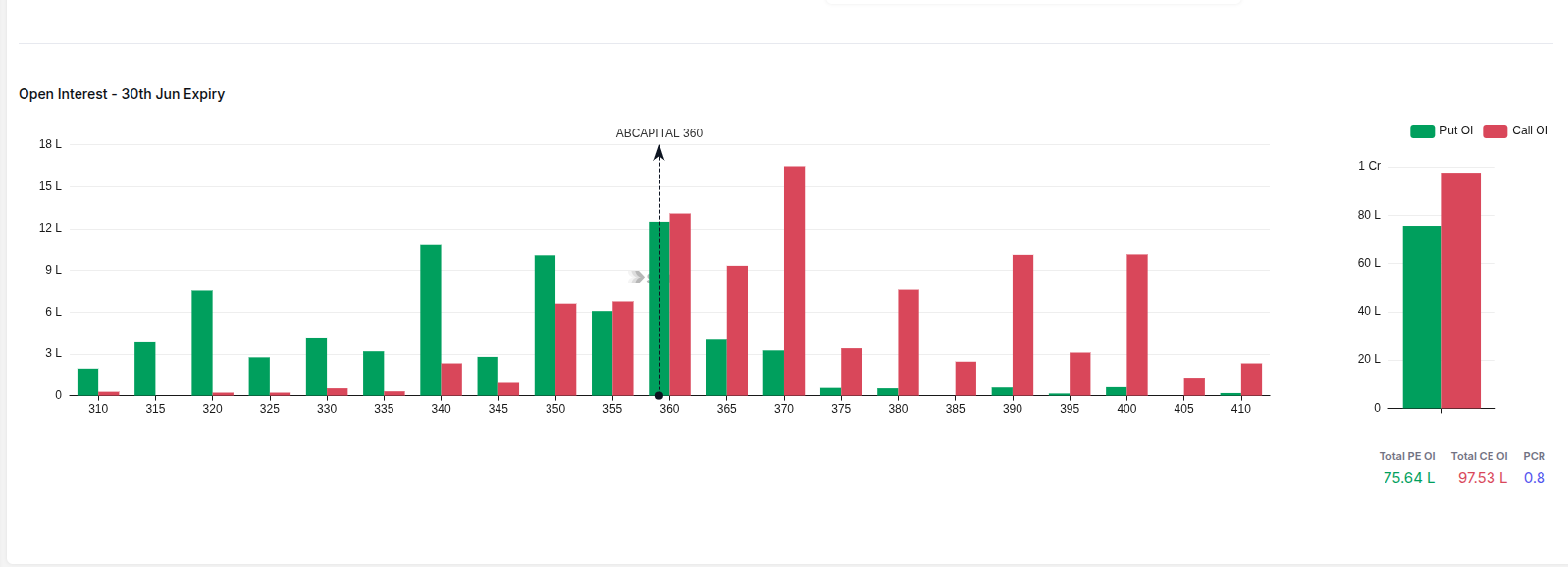
See OI Build Up Across Every Expiry

Stolo's OI chart overlays Call OI and Put OI side by side for every strike — across weekly and monthly expiries. Instantly spot where the maximum pain is, where resistance walls are forming, and which strikes are seeing heavy positioning.

  • Real-time OI updates every few seconds
  • Historical OI comparison across expiries
  • Max pain calculator built in
  • Change in OI (COI) highlighted visually
OI Chart

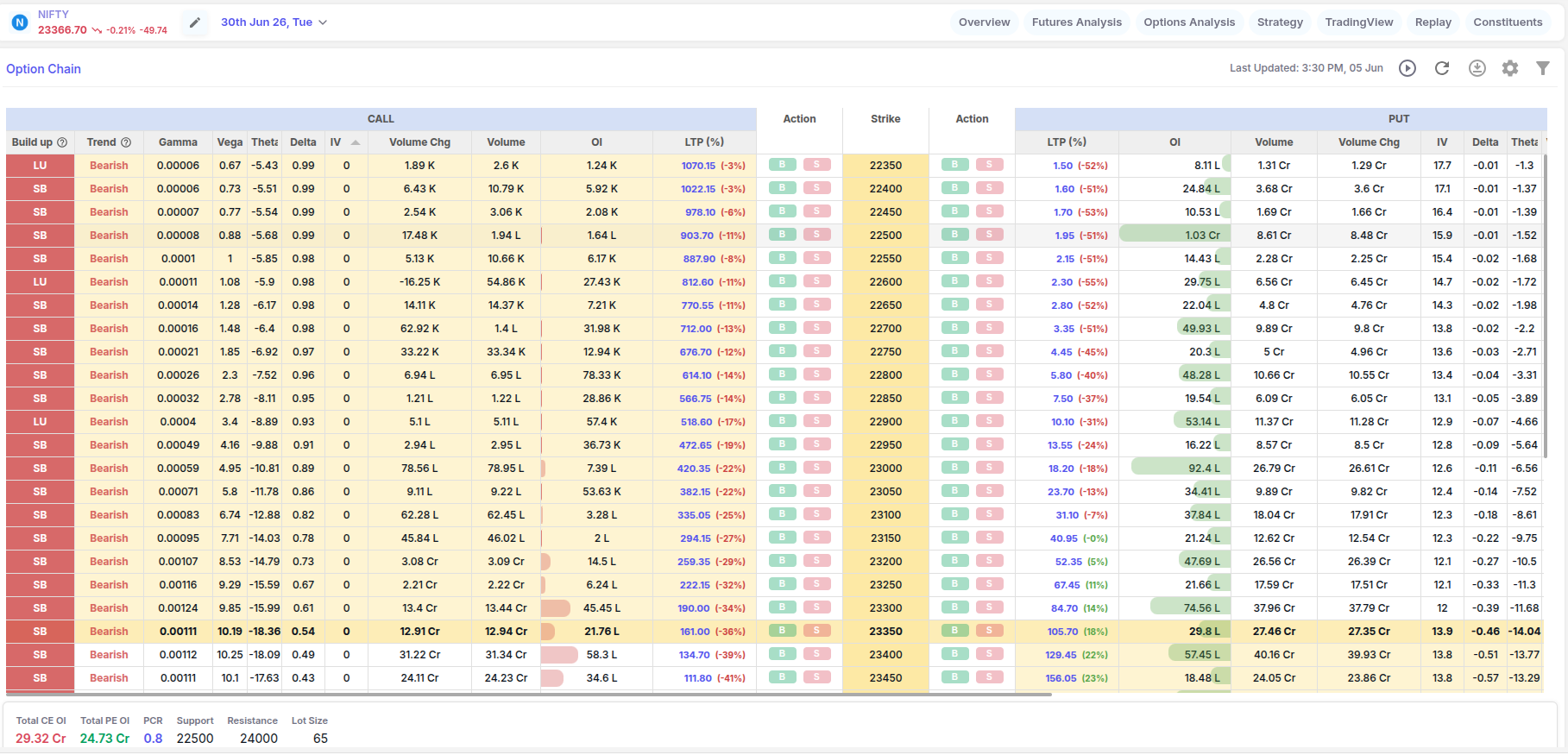
The Full Option Chain With OI Intelligence

Stolo's option chain doesn't just show you bid/ask. It layers OI data, Change in OI, IV percentile, and PCR right inside the chain — so you can interpret each strike without switching tabs.

  • Full NSE option chain with OI integration
  • Color-coded OI build-up vs unwinding
  • IV and Greeks alongside OI data
  • Multi-expiry view in one screen
Option Chain OI

Put-Call Ratio: The Sentiment Gauge

PCR (Put-Call Ratio) is one of the most reliable sentiment indicators in options trading. Stolo tracks PCR historically and in real time — so you can identify oversold/overbought conditions before they correct.
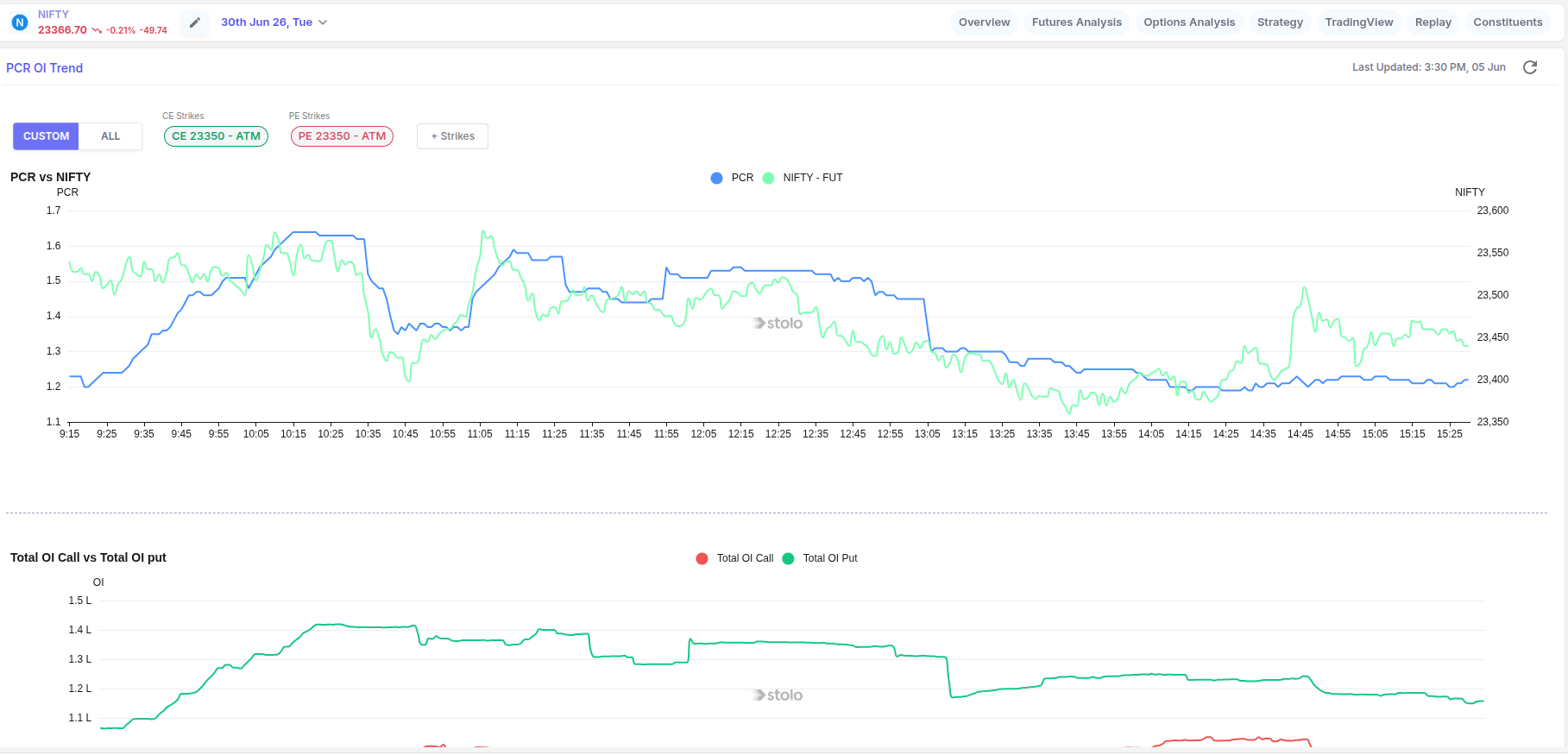
  • Real-time PCR tracking per instrument
  • Historical PCR with price overlay
  • Extreme PCR alerts (contrarian signals)
  • PCR trends across expiry cycles
PCR Analysis

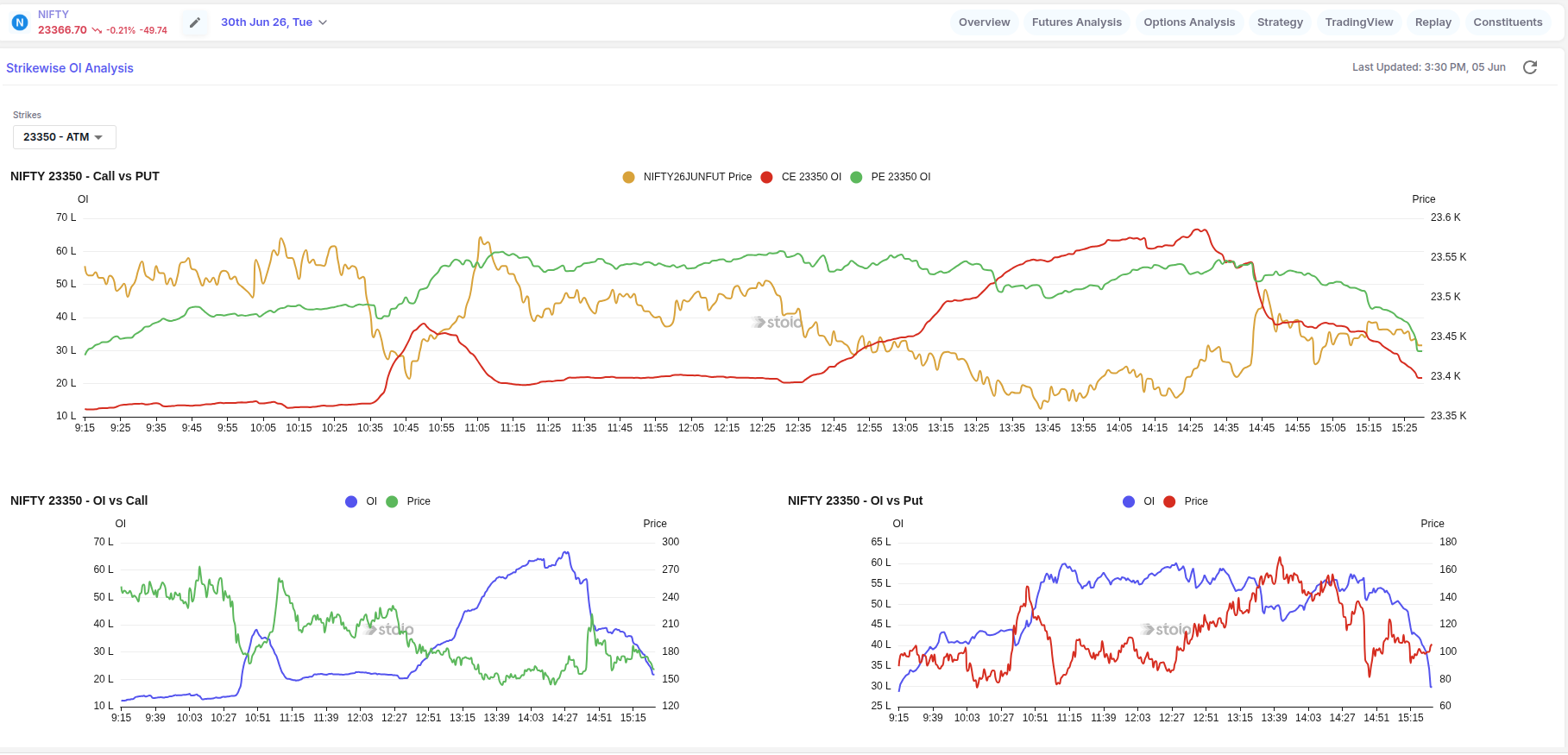
Find Every Major Support and Resistance Level

Strikes with the highest OI concentration act as natural support and resistance. Stolo maps this visually — so you can set targets, trail stops, and manage risk based on where the market is anchored.

  • Strike OI concentration heatmap
  • Top call writer and put writer strikes
  • Max pain visualised on chart
  • IOI (Intraday OI) changes tracked
Strike-wise OI

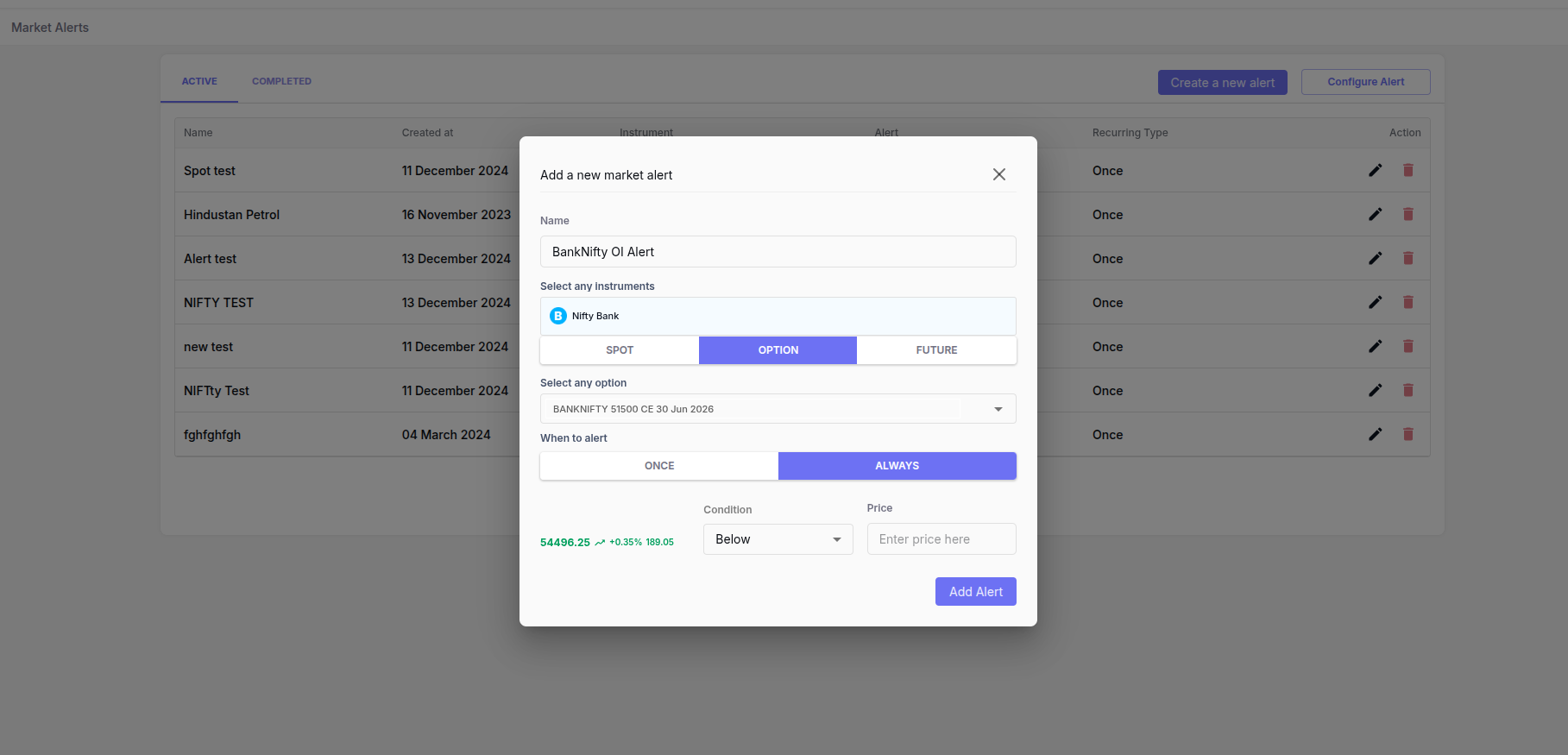
Get Notified When OI Moves — Not After

Set alerts for sudden OI build-up, sharp unwinding, or PCR extremes. Stolo sends you a notification the moment a significant OI event occurs — so you're never late to the party again.

  • Custom OI change threshold alerts
  • Sudden OI spike detection
  • Max pain shift notifications
  • Delivered via browser, app, and email
OI Alerts

What Does Open Interest Indicate?

OI alone is a number. OI combined with price and volume becomes a complete market narrative. Here are the four key signals every F&O trader must recognise.

Bullish Confirmation

Price Rising + OI Rising

New longs are entering the market with conviction. The trend has legs. This is the highest-confidence entry signal in trending markets.

Bearish Confirmation

Price Falling + OI Rising

Fresh shorts are being added aggressively. Sellers are building their positions — the trend is likely to continue lower before any meaningful reversal.

Short Covering

Price Rising + OI Falling

Short sellers are covering (buying back). The rise isn't driven by new longs — it's temporary. Do not chase this move without confirmation.

Long Unwinding

Price Falling + OI Falling

Existing longs are exiting their positions. This signals distribution. If OI drops significantly, the trend may be losing steam — time to reassess.

Read OI the Way Institutional Traders Do

Institutions don't just look at one OI data point. They read the complete picture — price context, strike concentration, PCR, and historical patterns — before making decisions. Here's the framework Stolo helps you build.

Apply This Framework Free
01

Identify the Strikes with Highest OI Concentration

Before anything else, find the Call and Put strikes with maximum open interest. These form the invisible walls — key support and resistance levels that price tends to gravitate toward (and violently reject or break).

02

Track Change in OI (COI) — Not Just Total OI

The rate of change matters more than the absolute OI number. A sudden spike in COI at a specific strike signals aggressive new positioning — an institutional footprint you can follow or fade.

03

Layer PCR to Gauge Market Sentiment

A rising PCR means more puts are being written — often bearish hedging. An extreme PCR (above 1.5 or below 0.7) tends to be a contrarian signal. Combine PCR with OI to filter out false moves.

04

Confirm with Price Action Before Entering

OI tells you where the positioning is. Price tells you when the move begins. Wait for price to confirm the OI signal — this reduces false entries significantly and keeps your discipline intact.

05

Review OI at Every Expiry Cycle

Each expiry cycle resets OI. Use Stolo's historical OI data to understand how positions evolved over the cycle — this gives you a template for the next one.

Open Interest vs Volume — What's the Difference?

Both are important. But they tell very different stories. Understanding the difference is one of the fastest ways to stop misreading the market.

Open Interest

The Position Counter

OI measures cumulative active contracts. It tells you how many participants are still committed to their positions.

  • Measures outstanding contracts
  • Rises when new positions are opened
  • Falls when positions are closed/expired
  • Indicates strength of a trend
  • Best for swing & expiry analysis
Volume

The Activity Counter

Volume counts how many contracts traded in a given period — regardless of whether they opened or closed positions.

  • Measures contracts traded in a period
  • Resets to zero each day
  • High volume = high activity, not direction
  • Good for intraday confirmation
  • Does not reveal sustained positioning

The Stolo edge: Our platform shows you both — with OI layered over price charts so you can see the full picture without switching tools.

See OI + Volume Together

India's Most Complete OI Analysis Platform

See how Stolo stacks up against typical broker platforms and generic screeners.

Feature Stolo Broker Platforms Generic Screeners
Real-time OI Chart Partial
Multi-expiry OI View
Historical OI Data Limited
PCR + OI Combined View Partial
OI Alerts
Max Pain Calculator Partial Partial
Educational OI Guides
Mobile Optimised Partial Partial

Questions?

Frequently Asked Questions about Open Interest

Direct answers to the most-searched questions about open interest and open interest charts
Still have questions? Our team typically replies in under 24 hours.
Ask us

Open interest is the total number of outstanding options or futures contracts in the market that have not yet been closed, exercised, or expired. It is a running cumulative count — not a daily reset like volume. When a buyer and a seller create a new contract, open interest increases by one. When an existing position is closed, open interest decreases by one. Open interest is one of the most powerful indicators of market direction, liquidity, and the strength behind a price move.

In an option chain, open interest is displayed for every individual strike price — both Call and Put options. It shows how many contracts are currently outstanding at each strike. Strikes with the highest Call OI typically act as resistance (because option writers are defending that level); strikes with the highest Put OI typically act as support. Reading open interest in the option chain helps traders identify the range the market is likely to trade within before expiry, and spot the strikes where the most institutional money is committed.

Open interest, read alongside price, indicates one of four things: (1) Long Build-Up — OI rising with price rising means fresh long positions are being created, confirming an uptrend. (2) Short Build-Up — OI rising with price falling means fresh short positions are being added, confirming a downtrend. (3) Short Covering — OI falling with price rising means shorts are closing, not new bulls entering — a potentially weak rally. (4) Long Unwinding — OI falling with price falling means bulls are exiting, not bears entering — a decline that may stabilise once unwinding is complete.

High open interest at a strike or in a contract means that a large number of positions are outstanding there. In options, high OI at a particular strike indicates significant institutional writing activity — making it a key support or resistance level. In futures, high OI in an expiry contract means the market has deep liquidity and strong directional commitment. Very high OI near expiry also concentrates gamma risk, meaning price moves can be amplified as positions are rolled or closed.

Volume counts the total number of contracts traded in a session and resets to zero every day. Open interest counts all contracts that are still open (not yet settled) and accumulates over time. Volume tells you how much activity happened; open interest tells you how many positions are still alive. When both volume and OI are rising, it confirms a strong trend with new money entering. When volume is high but OI is falling, it indicates position-closing activity rather than new commitment.

Open interest is updated throughout the trading session as contracts are opened and closed. When a new buyer and a new seller transact, OI rises. When an existing holder closes their position with another holder, OI falls. When an existing holder sells to a new buyer, OI stays the same. Stolo's open interest chart displays intraday OI changes in real time, so you can see exactly how market commitment is shifting through the session — not just the end-of-day snapshot.

Start by identifying whether OI is rising or falling alongside price to classify the move as a Long Build-Up, Short Build-Up, Short Covering, or Long Unwinding. Then check PCR to understand whether option writers are positioned bullish or bearish. Finally, look at Strikewise OI to find the strikes with the heaviest writing — these are your key support and resistance levels. Stolo's open interest chart brings all three signals together in one view.

There is no universal "good" number — open interest should always be compared in context. A sudden spike in OI (especially when accompanied by a price move) is more meaningful than an absolute level. For liquid instruments like Nifty and BankNifty, meaningful OI changes are measured in tens of thousands of contracts. For individual stocks, even a few thousand can be significant. Stolo's OI Change & Percentage Tracker highlights unusual build-ups automatically, so you focus on signals rather than raw numbers.

Yes. Stolo uses NSE-authorised data feeds — the same data source that institutional brokers and professional desks use. Open interest is refreshed in real time throughout the trading session. There is no scraping, no approximation, and no artificial delay. What you see on Stolo's open interest chart is what the market actually shows.

Yes. Stolo's open interest analysis covers all 191 NSE F&O stocks alongside Nifty, BankNifty, FinNifty, and MidCap Nifty. You can view OI change, PCR, Futures OI, and charted open interest history for every instrument individually — all within the same dashboard.

PCR is calculated directly from open interest: total Put OI ÷ total Call OI. A PCR above 1.2 indicates that more puts are written relative to calls — a bullish signal from the writers' perspective. A PCR below 0.8 indicates more call writing relative to puts — a bearish signal. PCR extremes in either direction often precede market reversals. Stolo calculates PCR from live OI data and displays it as a chart alongside open interest.

Yes. Stolo's open interest chart lets you view both intraday OI changes and multi-session historical OI data. You can study how OI behaved before past breakouts, compare current OI levels with the same point in previous expiry cycles, and build pattern-based intuition that improves with every trade. Historical OI data is available for indices and all 191 F&O stocks.
Open Interest Analysis Tool for NSE F&O Traders — Powered by Stolo
Platform Demo

Open Interest Analysis Tool for NSE F&O Traders — Powered by Stolo

Track real-time open interest, open interest charts, PCR, Futures OI, and Strikewise OI for Nifty, BankNifty, FinNifty, and all 191 NSE F&O stocks. Stolo's NSE-authorised Open Interest tool gives retail traders the market intelligence that institutions rely on every day.

Trader Voices

Why Smart Traders Choose Stolo?

Every trade carries a dream, a risk, a decision. Stolo is built for those who trade not just with numbers but with purpose, discipline, and the will to grow.

Kanna K
Advanced Trader

Kanna K

My first impression of your site, "K.I.S.S."..... Simple yet effective...uncluttered and has all the ingredients a trader actually needs not the nonsensical ones... great job

recommended Features

These are raw testimonials straight from the heart of traders who use Stolo from our Telegram community. Images are AI generated for representation only.

Shafeeq
Advanced Trader

Shafeeq

You have something unique in your platform that has changed my trading. I have used Quantsapp earlier didn't find it useful. I have tried opstra, sensibull etc.

recommended Features

These are raw testimonials straight from the heart of traders who use Stolo from our Telegram community. Images are AI generated for representation only.

Santosh Kumar
Advanced Trader

Santosh Kumar

Dear Sir, I am really impressed with the user interface and multiple other facilities for option traders.

recommended Features

These are raw testimonials straight from the heart of traders who use Stolo from our Telegram community. Images are AI generated for representation only.

You request we deliver. Only platform driven by open trader’s community.

Have questions or feature requests? Join our Telegram community to connect directly with the Stolo team. We are always listening!

Stolo Telegram Channel
Join our Telegram Channel
for more updates
Subscribe to YouTube Channel