Future vs Spot: Read the Basis
The futures chart and the cash chart of the same instrument are never quite identical. The gap between them, the basis, carries information: whether the futures market is confident or nervous, whether a breakout has conviction, and how much interest and dividend expectation is priced into the contract. Stolo's Future vs Spot view plots both price lines together so you watch that spread move instead of eyeballing two separate charts.
The problem it solves
Most traders look at one chart. The premium or discount of the future to spot is a separate signal that a price chart hides. A rally where the premium widens is a different animal to a rally where the premium shrinks, and only a side-by-side view shows you which one you are in.
The concept
- The future is priced off spot plus carry. Fair value is roughly the spot price plus the interest saved by not owning the underlying, minus expected dividends, over the time to expiry.
- A premium is normal. For an index, the future almost always trades slightly above spot. This is contango.
- A discount is a warning. A future below spot, backwardation, means sellers are aggressive or hedgers are paying up for protection.
- The basis converges at expiry. As time to expiry falls, the carry falls, and on expiry day the future settles at spot with no gap.
The excess of the premium over fair carry is what a cash and carry arbitrage captures: buy the underlying, sell the future, hold to expiry and pocket the difference. That arbitrage is what keeps the basis honest.
Key terms explained
| Term | What it means |
|---|---|
| Basis | Futures price minus spot price. |
| Premium / contango | Future above spot. The normal state. |
| Discount / backwardation | Future below spot. A stress signal. |
| Cost of carry | Interest saved by holding the future, less expected dividends, over time to expiry. |
| Convergence | The basis shrinking to zero as expiry approaches. |
| Cash and carry arbitrage | Buy cash, sell the future when the premium exceeds fair carry, hold to expiry. |
A worked example
NIFTY spot is at 22,000. The current-month future, with 12 days to expiry, trades at 22,055, a 55-point premium, roughly 0.25 percent, which is in line with fair carry.
- At 11:00 NIFTY breaks above 22,050. On the Future vs Spot view the premium widens to 90 points as price climbs. Buyers are paying up. The breakout has futures conviction and a trader takes the long.
- Two days later, price is testing 22,050 again from below, but this time the future is at a 10-point discount to spot. The futures market is now leaning short. The trader treats the level as more likely to break down and stands aside from the long.
How to use it in Stolo
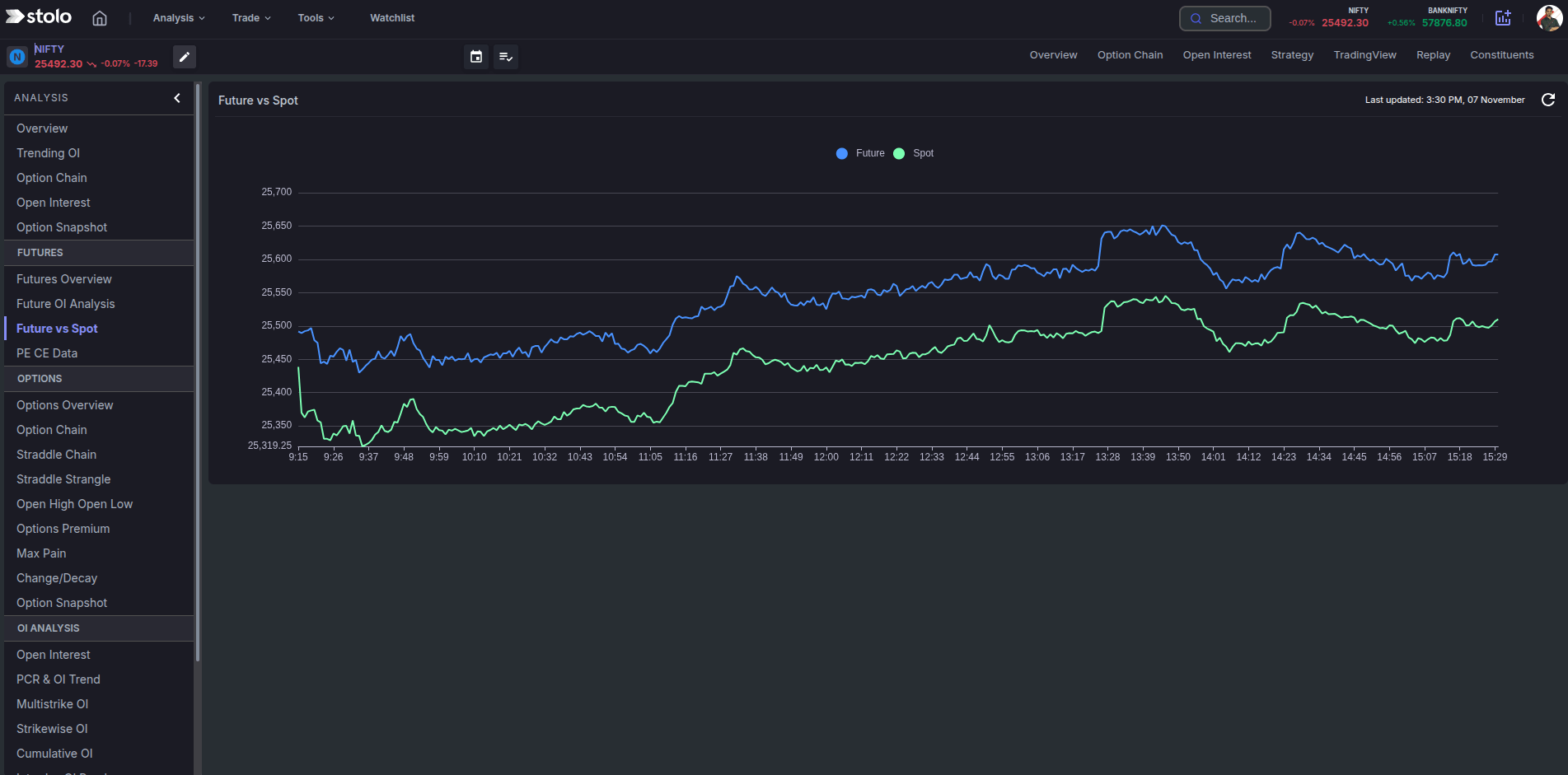
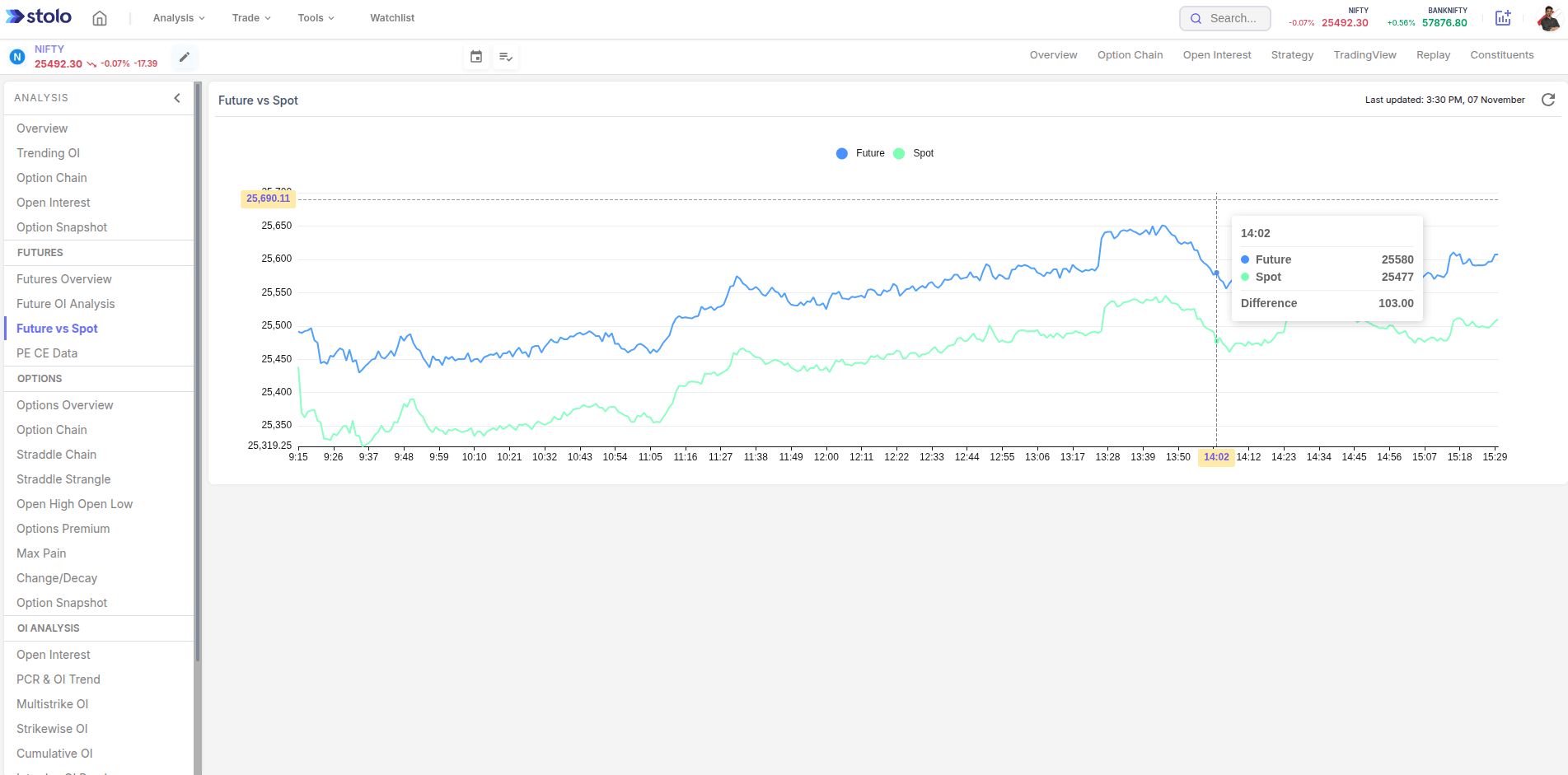

- Open Analysis, then Futures, then Future vs Spot.
- Choose the instrument.
- Read the two price lines and the spread between them: a premium is normal, a discount is a warning.
- Watch which way the spread is moving as price moves. Widening premium on a rally is confirmation; shrinking premium is a caution.
- Note the days to expiry, since the basis narrows naturally as expiry nears.
- Load a past date to see how the premium behaved into a previous expiry or event.
On expiry week, expect the premium to shrink on its own. Do not read that convergence as bearish; it is time value coming out, not selling.
How traders use it
- Breakout confirmation. Take an index breakout more seriously when the futures premium widens with it.
- Intraday bias. A NIFTY future sliding into discount during the day is an early bearish tell.
- Stock-specific read. A stock future at a persistent steep discount points to heavy short interest or an upcoming dividend.
- Roll and calendar timing. Watch the near-month basis into expiry to time the roll to the next contract.
Live mode and history mode
Live mode streams both price lines and the spread through the session. History mode redraws them for a past date, which is how you study how the basis behaved into a previous expiry or around an event.
Frequently asked questions
What is the basis in futures?
Why do futures trade at a premium to spot?
What does it mean when a future goes to a discount?
How do I use the future versus spot spread to confirm a breakout?
What is cash and carry arbitrage?
Should I trade off the futures chart or the spot chart?
Does the basis behave differently for stocks and indices?
Can I see the historical future versus spot spread?
What happens to the basis near expiry?
Which plan includes the Future vs Spot view?
Watch the basis, not just the price
Open Stolo's Future vs Spot view to track the futures premium or discount for any F&O instrument, live or on any past date.
Start with a Flexi Trial from ₹199