
Exchange: NSE
Type: Equity
Sector: Capital Goods
Disclaimer: KEI Industries Analysis pages are for educational purposes only with delayed data. One should not make any investment decisions based on the data provided here.
Analysis for KEI
KEI Overview
KEI Analysis
KEI Market Chart
KEI Option Chain
KEI Open Interest
KEI Straddle Chain
KEI Option Snapshot
KEI Straddle & Strangle
KEI Max Pain
KEI Options Premium
KEI Cumulative OI Change
KEI Open Hight Open Low
KEI Put Call Ratio (PCR)
KEI Multistrike OI Analysis
KEI Strikewise Oi Analysis
KEI Intraday OI Breakup
KEI Trending OI
KEI Premium Change / Decay
KEI Cumulative Volume
KEI Trending Volume
KEI Max Pain
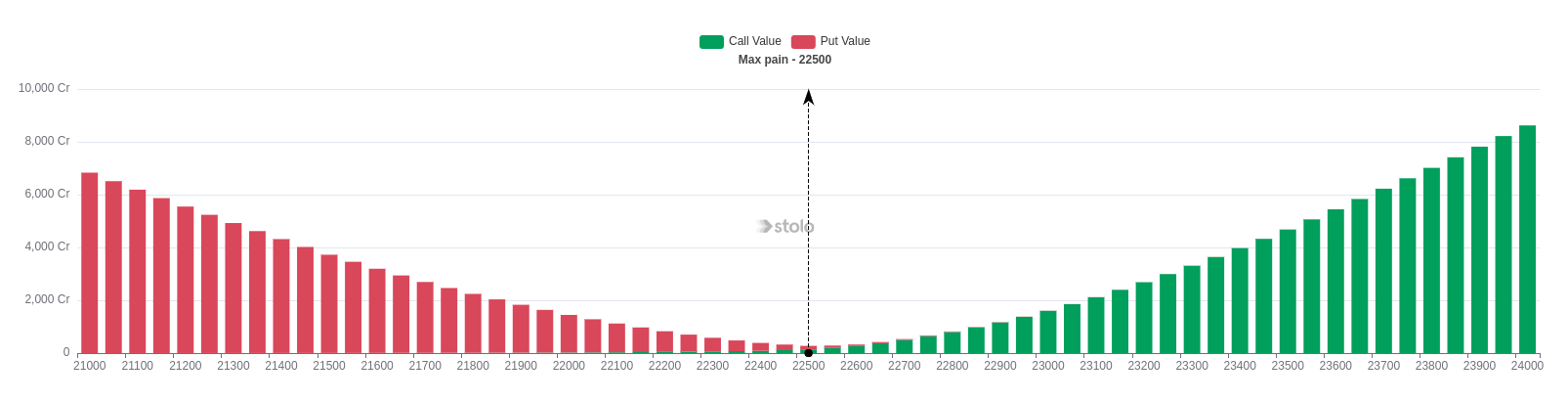
Explore Max Pain for KEI in Stolo
KEI Max Pain – Option Settlement Pressure & Strike Influence
The KEI max pain page on Stolo helps traders understand how option settlement dynamics may influence price behavior near expiration. Max pain refers to the strike price where option buyers collectively experience the maximum loss, based on open interest distribution. This concept is widely followed because it reflects where option sellers benefit the most. On Stolo, max pain is presented clearly so traders can evaluate how settlement pressure might affect KEI as expiry approaches.What Is KEI Max Pain?
Max pain is a theoretical price level calculated using open interest across all call and put strikes for a given expiration. It represents the price at which the total payout to option holders would be minimized. The KEI max pain value on Stolo is recalculated dynamically as open interest changes. This allows traders to see how settlement pressure evolves during the life of an options contract. While not a prediction tool, max pain offers insight into potential price magnet zones near expiry.Why Traders Monitor Max Pain for KEI
Max pain is often monitored because it highlights areas where options exposure is concentrated. When price approaches these levels near expiry, some traders observe price stabilization or reversion. On Stolo, KEI max pain helps traders:- Identify key expiry-related reference levels
- Understand option seller advantage zones
- Contextualize price movement during expiration week
How KEI Max Pain Is Calculated on Stolo
KEI Open Interest-Based Calculation
Max pain is derived by summing potential option payouts at each strike price using open interest data. The strike with the lowest total payout is identified as the max pain level. Stolo performs this calculation automatically for KEI, using the latest available open interest data to ensure accuracy. This removes the need for manual calculation and reduces errors.KEI Expiry-Specific Max Pain Levels
Each expiration date has its own max pain value. On Stolo, traders can view max pain for the nearest expiry as well as future expiries. This allows traders to compare how settlement pressure shifts over time for KEI, which is useful when planning multi-week strategies.How KEI Max Pain Data Is Presented on Stolo
Stolo presents max pain in a visual and numerical format to make interpretation easier. Traders typically see:- The calculated max pain strike
- Open interest distribution around that strike
- Comparison with current price