
Exchange: NSE
Type: Equity
Sector: Capital Goods
Disclaimer: KEI Industries Analysis pages are for educational purposes only with delayed data. One should not make any investment decisions based on the data provided here.
Analysis for KEI
KEI Overview
KEI Analysis
KEI Market Chart
KEI Option Chain
KEI Open Interest
KEI Straddle Chain
KEI Option Snapshot
KEI Straddle & Strangle
KEI Max Pain
KEI Options Premium
KEI Cumulative OI Change
KEI Open Hight Open Low
KEI Put Call Ratio (PCR)
KEI Multistrike OI Analysis
KEI Strikewise Oi Analysis
KEI Intraday OI Breakup
KEI Trending OI
KEI Premium Change / Decay
KEI Cumulative Volume
KEI Trending Volume
KEI Put Call Ratio (PCR)
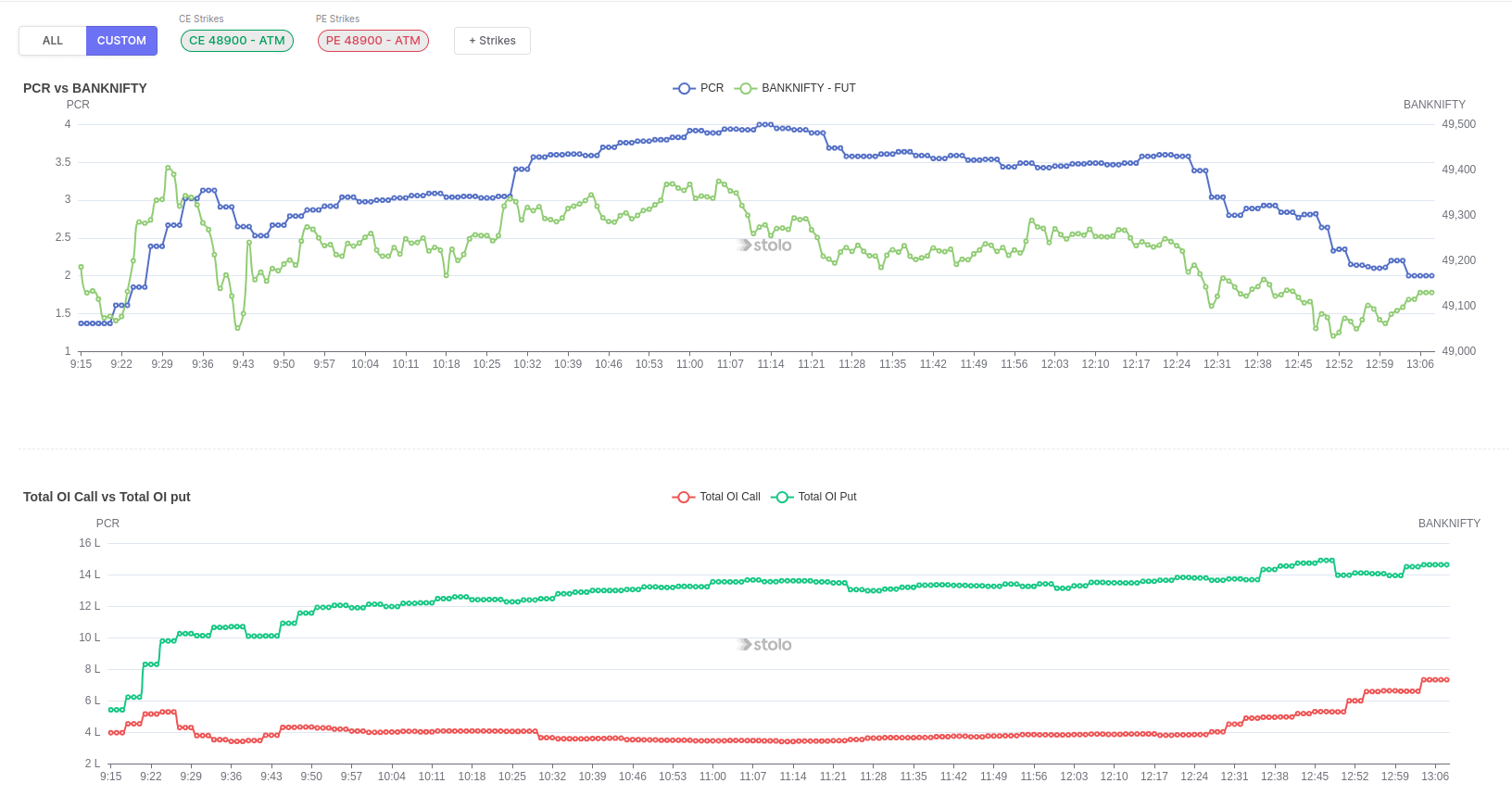
Explore Put Call Ratio (PCR) for KEI in Stolo
KEI Put Call Ratio (PCR) – Market Sentiment & Position Balance
The KEI Put Call Ratio (PCR) page on Stolo helps traders understand options market sentiment by comparing put activity to call activity. PCR is one of the most widely followed sentiment indicators because it reflects how traders are positioning for downside versus upside. Rather than acting as a buy or sell signal, PCR provides context. On Stolo, this context helps traders understand whether sentiment around KEI is balanced, skewed, or reaching an extreme.What Is KEI Put Call Ratio?
Put Call Ratio is calculated by dividing total put activity by total call activity for a given period. The result shows whether puts or calls dominate the options market. The KEI PCR on Stolo can be viewed using different bases, such as volume-based PCR or open-interest-based PCR. Each variation provides a slightly different perspective on sentiment. This metric answers a simple question: Are traders positioning more for protection or for upside in KEI?Why PCR Matters for KEI Traders
PCR matters because it captures collective positioning behavior. When put activity dominates, traders may be hedging or expressing bearish expectations. When call activity dominates, traders may be positioning for upside or momentum. The KEI PCR page on Stolo helps traders:- Gauge overall market sentiment
- Identify sentiment extremes
- Understand whether positioning is crowded
- Add context to price and volatility analysis
Types of KEI Put Call Ratio on Stolo
KEI Volume-Based Put Call Ratio
Volume-based PCR compares the number of put contracts traded to call contracts traded during the session. This version reflects current activity. On Stolo, volume-based KEI PCR helps traders understand intraday sentiment and short-term positioning shifts.KEI Open Interest-Based Put Call Ratio
Open-interest-based PCR compares outstanding put contracts to call contracts. This version reflects existing positions rather than daily trades. Stolo presents this variation to help traders understand longer-term positioning in KEI options.KEI Intraday vs Historical PCR Comparison
Stolo allows traders to compare current PCR values with historical ranges. This helps identify whether sentiment is normal or approaching extremes. Contextual comparison prevents overreaction to single data points.How KEI PCR Is Displayed on Stolo
The KEI PCR page on Stolo presents data in a clean, visual format. Traders typically see:- Current PCR value
- Intraday PCR trend
- Historical PCR range
- Call vs put participation summary