
Exchange: NSE
Type: Equity
Sector: Capital Goods
Disclaimer: KEI Industries Analysis pages are for educational purposes only with delayed data. One should not make any investment decisions based on the data provided here.
Analysis for KEI
KEI Overview
KEI Analysis
KEI Market Chart
KEI Option Chain
KEI Open Interest
KEI Straddle Chain
KEI Option Snapshot
KEI Straddle & Strangle
KEI Max Pain
KEI Options Premium
KEI Cumulative OI Change
KEI Open Hight Open Low
KEI Put Call Ratio (PCR)
KEI Multistrike OI Analysis
KEI Strikewise Oi Analysis
KEI Intraday OI Breakup
KEI Trending OI
KEI Premium Change / Decay
KEI Cumulative Volume
KEI Trending Volume
KEI Premium Change / Decay
Explore Premium Change / Decay for KEI in Stolo
KEI Premium Change / Decay – Theta Impact & Pricing Behavior
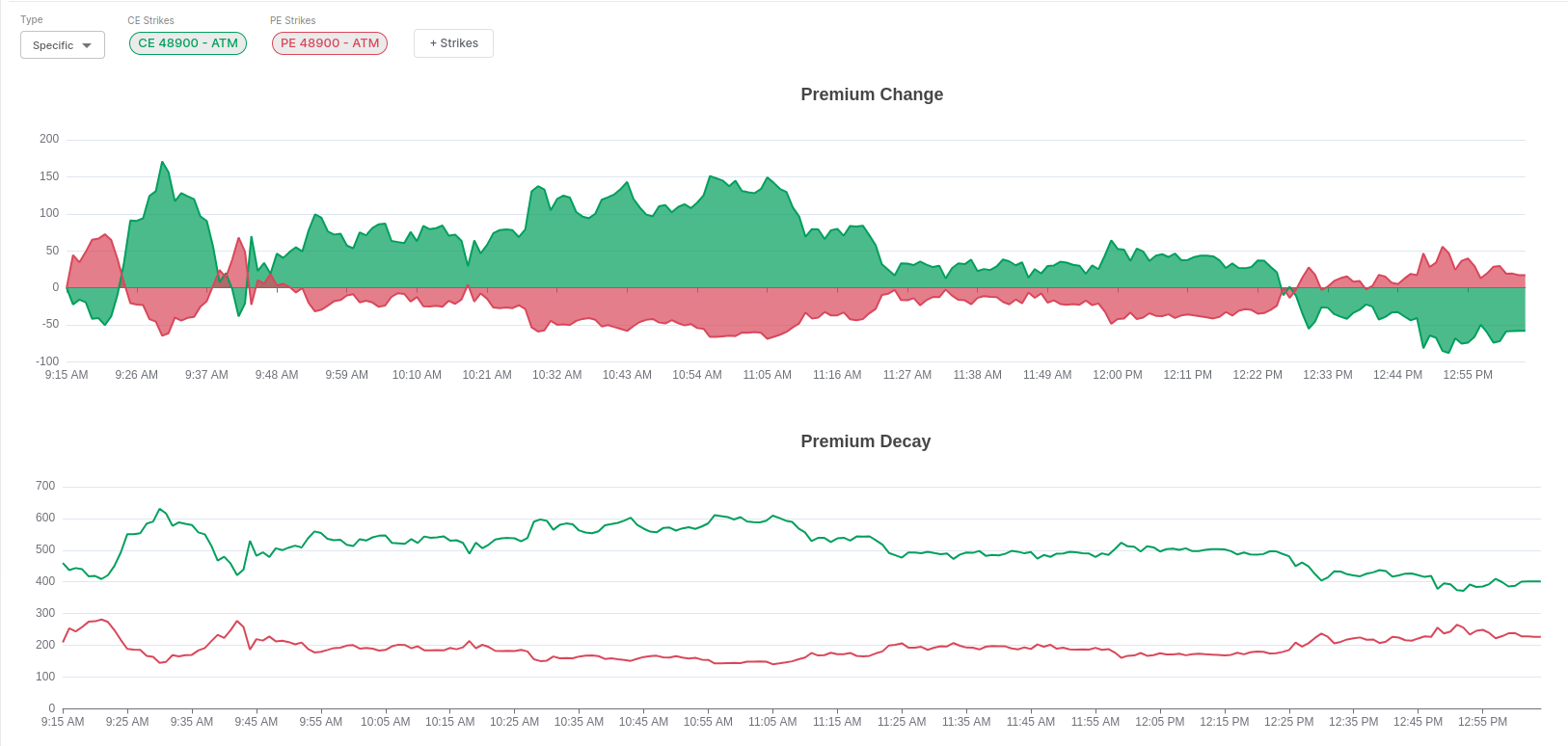
The KEI premium change and decay page on Stolo helps traders understand how option prices evolve throughout the trading session and as expiry approaches. Option premium does not remain static — it changes due to price movement, volatility shifts, and the passage of time. This page focuses specifically on how and why premiums change for KEI options. By tracking both premium movement and decay, Stolo helps traders evaluate whether premium behavior supports buying, selling, or staying neutral.What Is KEI Premium Change and Decay?
Premium change refers to how option prices move intraday due to underlying price action or volatility changes. Premium decay refers to the gradual erosion of option value over time, commonly known as theta decay. On Stolo, the KEI premium change / decay view answers an important question: Is option premium changing due to market movement, or is time decay the dominant force? Understanding this distinction is critical for selecting the right options strategy.Why Premium Change and Decay Matter for KEI Traders
Premium behavior directly affects profit and loss. Even if KEI price moves in the expected direction, unfavorable premium decay can reduce returns. The KEI premium change / decay page on Stolo helps traders:- Understand how fast premiums are eroding
- Identify periods of accelerated decay
- Distinguish between price-driven and time-driven premium changes
- Align strategies with premium behavior
Key Components of KEI Premium Change / Decay on Stolo
KEI Intraday Premium Change
Intraday premium change shows how option prices fluctuate during the session. On Stolo, traders can observe whether premium increases or decreases as KEI price moves. If premium rises sharply with price movement, volatility may be expanding. If premium fails to rise despite price movement, decay or volatility contraction may be offsetting gains. This observation helps traders interpret intraday option behavior accurately.KEI Time Decay (Theta) Effect
Time decay accelerates as expiration approaches. On Stolo, the premium decay view highlights how quickly option value erodes over time for KEI options. Short-dated options experience faster decay, while longer-dated options decay more slowly. Understanding this helps traders choose expiries that match their holding period. Theta awareness is especially important for option buyers.KEI Volatility-Driven Premium Changes
Premium can also change due to shifts in implied volatility. Rising volatility increases premium, while falling volatility reduces it. Stolo helps traders see whether KEI premium changes are driven by volatility expansion or contraction, allowing for better strategy alignment.How KEI Premium Change / Decay Is Displayed on Stolo
Stolo presents premium change and decay using comparative visuals and summary indicators. Traders typically see:- Net premium change by strike
- Relative decay across expiries
- Call vs put premium movement
- Indicators highlighting accelerated decay