
Exchange: NSE
Type: Equity
Sector: Realty
Disclaimer: Oberoi Realty Analysis pages are for educational purposes only with delayed data. One should not make any investment decisions based on the data provided here.
Analysis for OBEROIRLTY
OBEROIRLTY Overview
OBEROIRLTY Analysis
OBEROIRLTY Market Chart
OBEROIRLTY Option Chain
OBEROIRLTY Open Interest
OBEROIRLTY Straddle Chain
OBEROIRLTY Option Snapshot
OBEROIRLTY Straddle & Strangle
OBEROIRLTY Max Pain
OBEROIRLTY Options Premium
OBEROIRLTY Cumulative OI Change
OBEROIRLTY Open Hight Open Low
OBEROIRLTY Put Call Ratio (PCR)
OBEROIRLTY Multistrike OI Analysis
OBEROIRLTY Strikewise Oi Analysis
OBEROIRLTY Intraday OI Breakup
OBEROIRLTY Trending OI
OBEROIRLTY Premium Change / Decay
OBEROIRLTY Cumulative Volume
OBEROIRLTY Trending Volume
OBEROIRLTY Straddle Chain
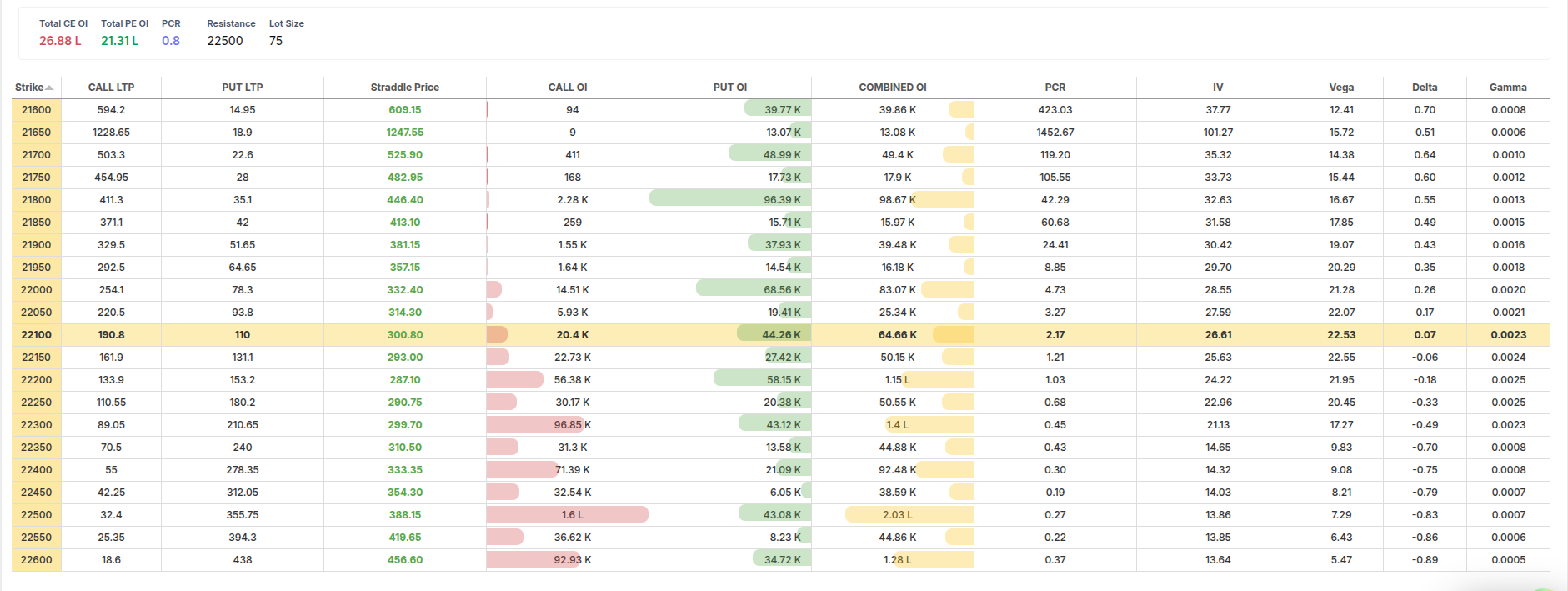
Explore Straddle Chain for OBEROIRLTY in Stolo
OBEROIRLTY Straddle Chain – Implied Move, Pricing & Breakeven Levels
The OBEROIRLTY straddle chain on Stolo helps traders understand how the options market is pricing future movement in OBEROIRLTY. A straddle combines a call and a put at the same strike and expiry, making it a pure volatility-focused position. This page is designed for traders who want to measure expected price movement, not just direction. By presenting straddle pricing, breakevens, and implied move data clearly, Stolo allows traders to assess whether the market is overpricing or underpricing risk in OBEROIRLTY.What Is a OBEROIRLTY Straddle?
A straddle is an options strategy that involves buying or selling both a call and a put at the same strike price and expiration date. The payoff depends on how much OBEROIRLTY moves, not whether it moves up or down. The OBEROIRLTY straddle chain on Stolo lists these combined positions across strikes and expiries, making it easy to compare pricing and expected movement in one view. This tool answers a critical question for traders: How much movement is the options market expecting from OBEROIRLTY?Why Traders Use the OBEROIRLTY Straddle Chain
Straddles are widely used around events, earnings, and periods of uncertainty. Traders turn to the OBEROIRLTY straddle chain on Stolo to evaluate whether implied expectations align with their own outlook. If the straddle price is high, the market expects significant movement. If the price is low, expectations are muted. Understanding this helps traders decide whether volatility is worth buying or selling in OBEROIRLTY. This page removes guesswork by showing implied expectations directly.Key Components of the OBEROIRLTY Straddle Chain on Stolo
OBEROIRLTY Straddle Pricing by Strike
Each row in the straddle chain represents a strike price, with the straddle premium calculated as the combined cost of the call and put at that strike. On Stolo, traders can quickly compare how straddle prices change as strikes move in-the-money or out-of-the-money. This comparison helps identify which strikes the market considers most sensitive for OBEROIRLTY. Pricing differences across strikes often reflect skew and positioning.OBEROIRLTY Implied Move Calculation
The implied move represents the expected price range the market is pricing into options until expiration. On Stolo, the implied move is derived from the straddle price and displayed clearly alongside each strike. For OBEROIRLTY, this value shows how far price would need to move for a straddle buyer to break even. Traders use this metric to compare market expectations against historical behavior or upcoming catalysts. This is one of the most valuable insights the straddle chain provides.OBEROIRLTY Breakeven Levels
Breakeven levels show the upper and lower price points where a straddle becomes profitable. On Stolo, these levels are calculated automatically for each strike and expiry. By reviewing breakevens, traders can visually understand the range OBEROIRLTY must trade within to benefit from buying or selling volatility. This helps in planning risk and reward clearly.How OBEROIRLTY Straddle Data Is Presented on Stolo
The OBEROIRLTY straddle chain on Stolo is structured for quick comparison. Traders can switch between expiries and instantly see how implied movement changes over time. Key elements include:- Combined straddle premium
- Implied move in points and percentage
- Upper and lower breakeven levels
- Liquidity indicators via underlying option data