The Indian derivatives market has grown into one of the most active in the world, and for good reason. FNO stocks stocks listed under the Futures and Options segment on NSE offer traders a powerful way to manage risk, hedge positions, and speculate on price movements without needing large upfront capital.
But not all FNO stocks are created equal. Liquidity, volatility, open interest, and underlying fundamentals all determine whether an F&O stock is worth your time and capital. In this post, we break down the top 10 FNO stocks to watch in 2023 chosen for their trading volume, market significance, and strategic value for retail traders.
Whether you are new to options trading or looking to sharpen your watchlist, this guide will help you trade with structure, not impulse.
What Are FNO Stocks?
FNO stocks are stocks approved by NSE (National Stock Exchange) for trading in the Futures and Options segment. SEBI sets strict eligibility criteria including minimum market capitalisation, trading volume, and price thresholds to ensure these stocks carry adequate liquidity.
For retail traders, FNO stocks offer:
- Leverage — control larger positions with smaller capital
- Hedging — protect existing portfolios from downside risk
- Strategy flexibility — build multi-leg options strategies like straddles, strangles, and spreads
- Price discovery — gauge market sentiment on individual stocks
“F&O volumes in India have surged significantly, with the NSE’s equity derivatives segment consistently ranking among the highest-volume derivatives exchanges globally.” — NSE Market Data, 2022–23
Understanding which FNO stocks have the depth and liquidity to support your strategy is the first step toward structured trading. Learn more about how options pricing works and what open interest tells you about market direction before diving in.
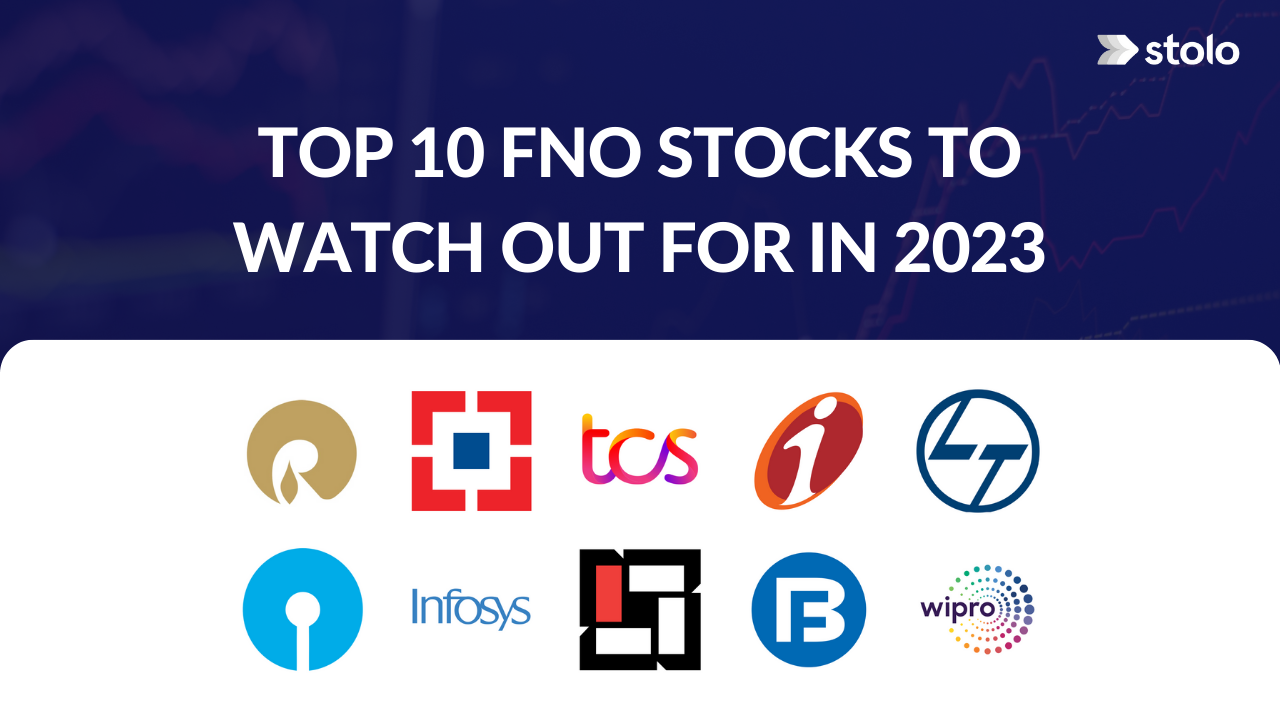
Top 10 FNO Stocks to look out for:
- Reliance Industries Limited (RIL)
- HDFC Bank
- TATA Consultancy Services (TCS)
- ICICI Bank
- Larsen & Toubro (L&T)
- State Bank of India (SBI)
- Infosys
- Housing Development Finance Corporation (HDFC)
- Bajaj Finance
- Wipro
1. Reliance Industries Limited (RIL)
NSE Symbol: RELIANCE
RIL is one of India’s largest conglomerates, spanning petrochemicals, refining, retail, and telecommunications through Jio. It became the first Indian company to cross a ₹20 lakh crore market capitalisation a milestone that underscores its weight in the index and in derivatives markets.
Why it matters for F&O traders:
- Extremely high liquidity in both futures and options contracts
- Frequent corporate events (AGMs, earnings, strategic announcements) create volatility windows
- Strong representation in Nifty 50, making it relevant for index-hedging strategies
What to watch: Jio’s competitive positioning in telecom and RIL’s green energy investments are key catalysts in 2023. Earnings quarters tend to see notable options activity.
2. HDFC Bank
NSE Symbol: HDFCBANK
HDFC Bank is India’s largest private-sector bank by market capitalisation. Its consistent earnings track record and institutional ownership make it a benchmark stock in the banking sector.
Why it matters for F&O traders:
- One of the most actively traded equities in the NSE F&O segment
- The HDFC–HDFC Bank merger completion in 2023 introduced a significant re-rating event — and with re-rating events come options opportunities
- Tight bid-ask spreads in near-month contracts make it ideal for spread strategies
What to watch: Post-merger integration progress, NIM (net interest margin) trends, and credit growth data are the key triggers to monitor.
3. TATA Consultancy Services (TCS)
NSE Symbol: TCS
TCS is India’s largest IT services company and a flagship of the Tata Group. With a global client base, stable cash flows, and consistent dividend payouts, it remains a cornerstone of the Indian equity market.
Why it matters for F&O traders:
- High stock price with liquid options at multiple strike prices
- Quarterly earnings calls regularly move the stock 2–5%, creating defined event-driven opportunities
- Popular for covered call strategies among longer-term holders
What to watch: Global IT spending trends, deal wins (Total Contract Value announcements), and rupee-dollar movement, as TCS earns a majority of revenue in USD.
4. ICICI Bank
NSE Symbol: ICICIBANK
ICICI Bank has transformed itself over the past decade into one of India’s most efficient private banks. It ranks among the top traded stocks in the F&O segment, with deep open interest across expiries.
Why it matters for F&O traders:
- Strong daily volume in both stock futures and options
- A relatively lower stock price compared to HDFC Bank makes it accessible for retail traders with tighter capital
- Sensitive to RBI rate decisions and banking sector news — good for event-driven strategies
What to watch: Asset quality metrics (NPA trends), loan growth, and RBI policy stance are the key variables for ICICI Bank options traders.
5. Larsen & Toubro (L&T)
NSE Symbol: LT
L&T is India’s largest engineering and construction conglomerate. Its business spans infrastructure, defence, technology services, and financial services — making it a proxy for India’s economic growth story.
Why it matters for F&O traders:
- High beta stock that responds sharply to Budget announcements and infrastructure policy news
- Order inflow updates create regular price triggers throughout the year
- Useful for traders positioning around government capex cycles
What to watch: Order book growth, margin improvement trends, and government infrastructure spending allocations. The defence sector push in India adds a fresh growth angle.
6. State Bank of India (SBI)
NSE Symbol: SBIN
SBI is India’s largest public-sector bank by assets, deposits, and branch network. It is a favourite among retail traders precisely because of its high volume, accessible stock price, and sensitivity to macroeconomic shifts.
Why it matters for F&O traders:
Put this knowledge to work. Stolo gives you real-time options analytics, live Greek values, OI charts, and strategy builders — built for Indian retail traders.
Try Stolo- Very high open interest and liquidity — ideal for beginners exploring stock F&O
- Strong response to rate cycles and government policy shifts
- Budget season and credit policy meetings regularly catalyse sharp moves
What to watch: Loan growth, NPA trajectory, and RBI rate decisions. SBI’s performance often serves as a bellwether for the broader public-sector banking space.
7. Infosys
NSE Symbol: INFY
Infosys is the second-largest Indian IT services company and a global benchmark for operational efficiency in the sector. Quarterly earnings often set the tone for the entire IT sector.
Why it matters for F&O traders:
- Infosys earnings releases are among the most closely watched events for IT sector traders
- Revenue guidance updates can move the stock 5–10% on results day — creating compelling options strategies around earnings
- One of the few Indian stocks also listed on NYSE (NYSE: INFY), giving it international investor attention
What to watch: Revenue guidance, deal wins, attrition rates, and global macro headwinds affecting IT budgets. The US and European demand environment is the primary lens.
8. Housing Development Finance Corporation (HDFC)
NSE Symbol: HDFC
HDFC was India’s premier housing finance company before its merger with HDFC Bank was completed in 2023. This was one of the largest merger events in Indian corporate history — and created significant F&O activity throughout the year as arbitrageurs and directional traders positioned around the merger timeline.
Why it matters for F&O traders:
- The merger swap ratio and completion timeline kept options volatility elevated in the first half of 2023
- Post-merger, HDFC as a standalone entity ceased trading — but its legacy liquidity profile made it one of the most instructive cases for event-driven F&O strategies
What to watch: For traders studying this stock, the merger is a valuable case study in how corporate events affect options pricing and implied volatility.
9. Bajaj Finance
NSE Symbol: BAJFINANCE
Bajaj Finance is one of India’s leading non-banking financial companies (NBFCs). It is known for rapid loan book growth, technology-first lending, and consistent earnings delivery.
Why it matters for F&O traders:
- High-beta NBFC stock with sharp moves during earnings and RBI commentary
- Sensitive to consumer credit data and interest rate environment
- Popular among momentum traders for intraday F&O positioning
What to watch: AUM (Assets Under Management) growth, credit cost trends, and RBI regulations around digital lending and consumer credit. The stock can move sharply on NBFC sector news.
10. Wipro
NSE Symbol: WIPRO
Wipro is one of India’s major IT services companies, with a global presence across consulting, cloud, and engineering services. While it has underperformed peers in recent years, it remains an active F&O stock.
Why it matters for F&O traders:
- Competitive pricing due to a lower stock price relative to TCS and Infosys
- Useful for pairs trading strategies within the IT sector (long one IT stock, short another)
- Earnings and guidance updates create defined volatility events
What to watch: New CEO strategy execution, large deal momentum, and margin trajectory. The stock’s relative underperformance to Nifty IT Index makes it interesting for relative value strategies.
How to Approach FNO Stocks as a Retail Trader
Picking the right FNO stock is only half the equation. How you approach trading it matters more.
Here is a structured framework to think about before entering any F&O position:
1. Understand Liquidity First
Always check open interest and daily traded volume before placing options orders. Low liquidity means wide spreads — and wide spreads quietly eat into your P&L even before the market moves.
2. Know Your Catalyst
Are you trading based on earnings? A macro trigger? A technical breakout? Define your reason clearly. A position without a clear thesis is just hope — and hope is not a strategy.
3. Size Appropriately
F&O leverage can amplify both gains and losses. Risk only what you can afford to lose on a single trade. Never put your entire capital into one speculative position.
4. Have an Exit Plan Before You Enter
Decide your stop-loss and profit target before you take the trade. Once you are in a position, emotion clouds judgment. Set your rules when you are calm — not after the market has already moved.
5. Review After Every Trade
A trade diary is one of the most underused tools by retail traders. Recording what you expected, what happened, and why creates a feedback loop that is hard to replicate any other way. Stolo’s trade journaling features are designed exactly for this.
“The goal of a successful trader is to make the best trades. Money is secondary.” — Alexander Elder, Author of Trading for a Living
Frequently Asked Questions (FAQs)
Q1. What are FNO stocks?
FNO stocks are equities approved by NSE for trading in the Futures and Options segment. They meet SEBI’s eligibility criteria for liquidity, market cap, and trading volume.
Q2. How many stocks are in the NSE F&O segment?
As of 2023, NSE has around 182–200 stocks approved for F&O trading. The list is reviewed periodically by SEBI based on liquidity and market cap criteria.
Q3. Which FNO stock is best for beginners?
Stocks like SBI, ICICI Bank, and Infosys are often considered more accessible for beginners due to their liquidity, lower stock price, and predictable event triggers. That said, no F&O stock is truly “safe” for undisciplined trading. Start with paper trading or smaller lots to build confidence.
Q4. How does Stolo help with F&O trading?
Stolo provides real-time option chain analysis, open interest data, strategy builders, and post-trade reflection tools — all built specifically for Indian retail traders. Instead of navigating fragmented data across multiple platforms, you get everything you need in one structured workspace. Explore Stolo’s options analytics tools.
Q5. What is the difference between stock futures and stock options?
Stock futures lock you into a buy or sell obligation at a set price by a fixed date. Stock options give you the right but not the obligation to buy or sell at a set price. Options come with a premium cost but limit your maximum loss to that premium (for buyers).
Q6. Can I trade F&O stocks without a large capital base?
Options buying requires only the premium amount, which is significantly lower than futures margin requirements. However, options selling (writing) requires margin. Stolo’s tools help you visualise the margin requirement and potential payoff before you commit capital, so you can plan accordingly.
Q7. How do I track open interest for FNO stocks?
Open interest data is available on NSE’s official website and through platforms like Stolo, which display OI changes visually alongside price action to help you read market sentiment more effectively. Learn how to read open interest data.
Conclusion
The top 10 FNO stocks listed here RIL, HDFC Bank, TCS, ICICI Bank, L&T, SBI, Infosys, HDFC, Bajaj Finance, and Wipro represent the backbone of India’s derivatives market. They offer the liquidity, volatility, and fundamental depth that structured traders look for.
But knowing which stocks to watch is just the starting point. The real edge comes from how you analyse, plan, and execute and how you reflect and improve after every trade.
At Stolo, we are building tools that help Indian retail traders move away from reactive, emotion-driven trading toward structured, data-backed decision-making. Whether you are building multi-leg options strategies, tracking open interest shifts, or reviewing your trade journal, Stolo is designed to be your trading companion not just a data terminal.
Ready to trade FNO stocks with clarity and structure? Explore Stolo’s options trading platform and see how structured trading intelligence can change the way you approach the market.
Disclaimer: This blog post is for educational purposes only and does not constitute financial advice. Options and futures trading involves significant risk. Please consult a SEBI-registered advisor before making investment decisions.

Written & reviewed by Stolo Research Team
This content is produced by experienced options traders and market analysts at Stolo — India's trading intelligence platform trusted by 58,000+ retail traders across NSE-authorised live data.


