Options trading gives you dozens of ways to structure a position, and picking the right options trading strategy for your market view and risk appetite can be the difference between a well-managed trade and an expensive lesson. This guide walks through 10 of the most widely used options trading strategies: how each one is built, when traders typically reach for it, and its basic risk and reward profile.
Want to test these out before risking real capital? Explore Stolo’s Options Strategy Builder to build and visualize these trading strategies before you place a trade.
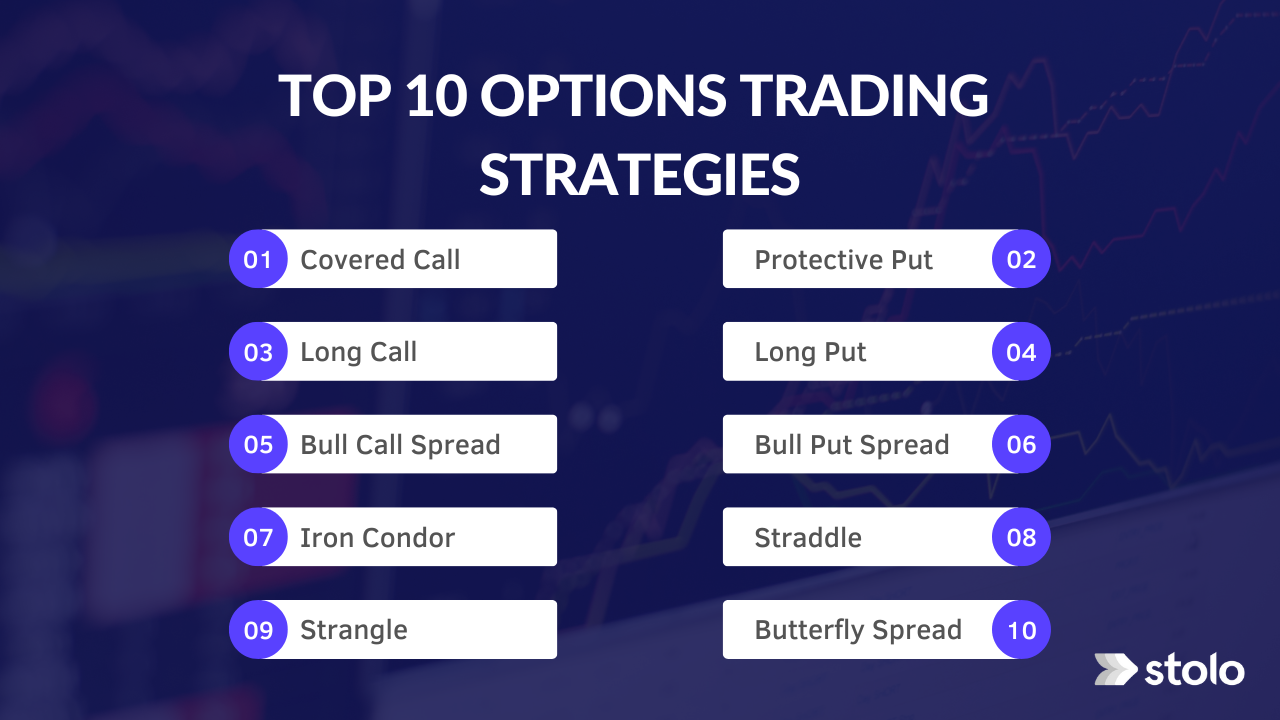
Top 10 Options Trading Strategies
- Covered Call
- Protective Put
- Long Call
- Long Put
- Bull Call Spread
- Bear Put Spread
- Iron Condor
- Straddle
- Strangle
- Butterfly Spread
1. Covered Call
A covered call strategy means selling (writing) a call option against a stock you already own. You collect the premium upfront, which gives you a limited cushion against a drop in the stock’s price, but you also cap your upside at the strike price if the stock rallies past it.
- Market outlook: Neutral to mildly bullish
- Max profit: Limited (the premium received, plus any stock gain up to the strike price)
- Max loss: Substantial. The stock can still fall sharply, and the premium only partly offsets that loss
2. Protective Put
A protective put means buying a put option on a stock you already own, essentially insurance against a drop in price. If the stock falls, gains on the put help offset the loss on your holding; if it doesn’t, you’re only out the premium paid.
- Market outlook: Bullish long-term, but hedging near-term downside
- Max profit: Unlimited (the stock’s upside is uncapped, reduced only by the premium paid)
- Max loss: Limited (capped near the difference between your purchase price and the strike, plus the premium paid)
3. Long Call
A long call strategy means buying a call option, betting that the underlying’s price will rise, without needing to own the stock itself.
- Market outlook: Bullish
- Max profit: Unlimited, since a stock’s price has no ceiling
- Max loss: Limited to the premium paid
4. Long Put
A long put strategy means buying a put option, betting that the underlying’s price will fall.
- Market outlook: Bearish
- Max profit: Large but finite, since a stock’s price can only fall to zero, so profit is capped at the strike price minus the premium paid
- Max loss: Limited to the premium paid
5. Bull Call Spread
In a bull call spread strategy, you buy a call option at a lower strike price and sell a call option at a higher strike price, same expiry. Selling the higher-strike call offsets part of the cost of the lower-strike call, lowering your net premium and your maximum possible loss, in exchange for capping your maximum profit.
Put this knowledge to work. Stolo gives you real-time options analytics, live Greek values, OI charts, and strategy builders — built for Indian retail traders.
Try Stolo- Market outlook: Moderately bullish
- Max profit: Limited to the difference between the two strikes, minus the net premium paid
- Max loss: Limited to the net premium paid
6. Bear Put Spread
A bear put spread strategy means buying a put option at a higher strike price and selling a put option at a lower strike price, same expiry. The premium from the put you sell reduces your net cost and your maximum possible loss, while capping your maximum profit.
- Market outlook: Moderately bearish
- Max profit: Limited to the difference between the two strikes, minus the net premium paid
- Max loss: Limited to the net premium paid
7. Iron Condor
An iron condor strategy combines a bear call spread and a bull put spread on the same underlying and expiry. You sell an out-of-the-money put and an out-of-the-money call closer to the current price to collect premium, while buying a further out-of-the-money put and call on each side as protection. The trade profits if the stock stays within the range defined by the strikes you sold.
- Market outlook: Neutral, range-bound, expecting low volatility
- Max profit: Limited to the net premium (credit) received
- Max loss: Limited, defined by the gap between the strikes you bought and sold, minus the credit received
8. Straddle
A straddle strategy means buying a call and a put at the same strike price and expiry. It profits from a large move in either direction, so the underlying needs to move enough to cover the combined premium paid on both legs before the trade turns profitable.
- Market outlook: Expecting a big move, direction uncertain (long volatility)
- Max profit: Large: unlimited on the upside via the call, and large but finite on the downside via the put
- Max loss: Limited to the total premium paid for both options
9. Strangle
A strangle strategy is similar to a straddle, but uses an out-of-the-money call and an out-of-the-money put at different strikes instead of a single strike. It costs less upfront than a straddle, but needs an even bigger move in the underlying to turn a profit.
- Market outlook: Expecting a big move, direction uncertain (a lower-cost alternative to a straddle)
- Max profit: Large, with the same asymmetric profile as a straddle (unlimited via the call, large but finite via the put)
- Max loss: Limited to the total premium paid
10. Butterfly Spread
A (long call) butterfly spread is built by buying one lower-strike call, selling two calls at a middle strike, and buying one higher-strike call, all with the same expiry (the same structure works with puts too). It’s a net-debit trade that profits if the stock settles close to the middle strike at expiry. It’s narrower in scope than a strategy like the iron butterfly, which achieves a similar payoff using a net credit instead.
- Market outlook: Neutral, expecting the stock to stay close to the middle strike
- Max profit: Limited, achieved if the stock finishes exactly at the middle strike at expiry
- Max loss: Limited to the net premium paid
Quick Comparison: Options Trading Strategies at a Glance
| Strategy | Market Outlook | Max Profit | Max Loss |
|---|---|---|---|
| Covered Call | Neutral to mildly bullish | Limited (premium + gain to strike) | Substantial (stock risk, offset by premium) |
| Protective Put | Bullish, hedging downside | Unlimited | Limited |
| Long Call | Bullish | Unlimited | Limited to premium paid |
| Long Put | Bearish | Large but finite | Limited to premium paid |
| Bull Call Spread | Moderately bullish | Limited | Limited |
| Bear Put Spread | Moderately bearish | Limited | Limited |
| Iron Condor | Neutral, range-bound | Limited (net credit) | Limited |
| Straddle | Big move, either direction | Large (unlimited via call) | Limited to premium paid |
| Strangle | Big move, either direction | Large (unlimited via call) | Limited to premium paid |
| Butterfly Spread | Neutral, pinned to middle strike | Limited | Limited to premium paid |
FAQs
What’s the safest options trading strategy for beginners?
Covered calls and protective puts are usually a reasonable starting point, since both involve a stock position you already understand and have a clearly defined outcome. Multi-leg strategies like iron condors and butterfly spreads are worth attempting once you’re comfortable with strike selection and options pricing.
Do I need to own the underlying stock to use these strategies?
Only two of them. Covered calls and protective puts require you to already hold the stock. The rest (long calls, long puts, spreads, straddles, strangles, iron condors, and butterfly spreads) are built entirely from options contracts and don’t require stock ownership.
Which options trading strategy works best in a volatile market?
Straddles and strangles are built for volatile, direction-uncertain markets, since they profit from a large move either way. Range-bound, low-volatility markets tend to favor iron condors and butterfly spreads instead.
Can I lose more than my premium with these strategies?
It depends on the strategy. Buying options outright (long calls, long puts, straddles, strangles) limits your maximum loss to the premium paid. Strategies built around an existing stock position, like covered calls, carry the underlying stock’s own risk beyond just the premium, so it’s worth understanding the full risk profile before trading it.
How do I choose which options trading strategy to use?
Start with your market outlook (bullish, bearish, or neutral) and how confident you are in that view. A strong directional view suits long calls or long puts; a moderate view suits spreads, which reduce cost and risk; and an uncertain-but-expecting-movement view suits straddles or strangles, while a low-volatility, range-bound view suits iron condors or butterfly spreads.
Conclusion
Options trading can be a valuable addition to any investor’s portfolio with enough information and practice. Understanding these top 10 options trading strategies is an important step toward becoming a better options trader, and each one has its own advantages and drawbacks. Choosing the right one comes down to your risk tolerance, your goals, and current market conditions. Explore Stolo’s Options Trading Platform to put these strategies to work with tools like option chain analysis, open interest data, and more.

Written & reviewed by Stolo Research Team
This content is produced by experienced options traders and market analysts at Stolo — India's trading intelligence platform trusted by 58,000+ retail traders across NSE-authorised live data.


