Trader Voices
Why Smart Traders Choose Stolo?
Every trade is a small bet on a dream, backed by risk and a decision you have to own. Stolo is built for traders who bring purpose and discipline to that decision, not just numbers.
Stolo Ultimate Options Trading Journal - Stolo’s ultimate trading journal is all you would need to track your trades and analyze them effectively. With insight driven data entry and advanced analytics take trading to the next level with Stolo.
Paid trial from ₹199 · Full Pro access · Setup in 3 minutes

They have a broker statement. They have a P&L number. What's missing is a trading journal, and that missing piece is exactly where improvement stalls out.
By your third trade of the day, you can't accurately recall why you entered the first one. Memory edits things out on its own, quietly dropping the hesitation, the second-guessing, the emotional pull. A trading journal captures the truth in real time instead of the story you tell yourself later.
Your broker statement will tell you that you lost ₹3,200 on Tuesday. What it won't tell you is that you were anxious all morning and placed three revenge trades in a row. Without that context, a loss just stays a number and the pattern behind it stays invisible.
Most F&O losses trace back to behavior, not a technical failure. FOMO, overconfidence, revenge trading, and panic exits do far more damage than a wrong market read ever does. Skip emotion tracking and you're trying to fix something you can't even see.
Even traders who keep a spreadsheet rarely notice that 70% of their Big Loss trades happen after 2 PM, or that every FOMO entry ends in a loss. Stolo surfaces those patterns automatically, so blind spots show up without you manually scanning hundreds of records.
Numbers tell you what happened. A well-kept trading journal tells you why, and that's really the only information that helps you trade better.
Your broker statement covers the what: instrument, price, quantity. Stolo's journal goes after the how and why, capturing your pre-session market bias, your mood, your entry and exit reasoning, and the emotion behind every decision, so you end up with a full picture of your process and not just your results.
Behavioral finance research keeps finding the same thing: retail traders' biggest losses cluster around specific emotional states like FOMO, overconfidence, and post-loss panic. That's why Stolo makes emotion tracking mandatory at trade entry, since it is one of the strongest predictors of whether a trade was disciplined or impulsive. A trader who can see the pattern is a trader who can actually change it.
A simple win/loss label misses too much, so Stolo uses four outcome buckets instead: Big Profit, Small Profit, Small Loss, Big Loss, assigned by you rather than the system. A profitable revenge trade can still land in the Big Loss bucket on the discipline scale, because the process was wrong even when the number came out positive. That honest distinction is where real improvement actually starts.
Eight modules built for F&O traders who know that improving their process matters more than celebrating their results.

Every closed session gets archived in a calendar heatmap, color-coded by outcome and discipline score. Jump into any past session and you'll see the full trade timeline, your pre-session plan, and your end-of-day reflection exactly as you logged it.

Get a monthly breakdown of net P&L, total trades, win rate, and your best and worst sessions. This is where you see whether your strategy is improving, plateauing, or eroding, something no amount of trade-by-trade review will tell you.

After 10 journaled sessions, Stolo auto-generates behavioral pattern observations from your own trade data. It shows which emotion-to-outcome patterns define your biggest losses and which entry triggers consistently deliver your best results.

Filter your journal by any specific date to review the full session: every trade in sequence, your pre-session plan, and your end-of-day reflection, with nothing lost no matter how many sessions ago it happened.

Log trades for Nifty, BankNifty, FinNifty, MidCap Nifty, or any NSE F&O stock. Select the instrument for each entry so your monthly overview is always segmented by the instruments you actually trade.

Every trade gets classified as Big Profit, Small Profit, Small Loss, or Big Loss, and you're the one assigning it, not the system. That forces honest self-labeling and keeps disciplined planned losses separate from impulsive emotional ones, which is exactly the distinction accurate pattern detection depends on.

Log any trade in under 30 seconds via the Quick-Log bottom sheet: five fields, one tap to save. Trades with incomplete context get an "Add detail later" badge, so nothing gets missed even during an active scalping session.

Record entry and exit logic in free text, apply entry trigger tags (OI buildup, PCR signal, breakout, FOMO), upload chart screenshots up to 5 MB, and mark mistake tags. Every entry ends up telling the complete story of that decision, not just the numbers behind it.
Before the market opens, Stolo prompts you with a four-field pre-session setup: your market bias (Bullish, Bearish, Sideways, Uncertain), your mood today, your maximum risk in rupees for the session, and your plan in 280 characters, covering what you intend to focus on and what you will avoid.
That pre-session context gets compared against your actual outcomes in the end-of-day reflection. Once you see the gap between what you planned and what you executed, the pattern is hard to ignore. The lesson it produces then becomes a 140-character note that Stolo surfaces at the start of your very next session, so yesterday's learning actually leads tomorrow's behavior.
Start Your Trading Journal

The trade entry form captures the factual data (instrument, direction, entry and exit prices, lots, times) alongside the behavioral context: why you entered, why you exited, which entry trigger applied (OI buildup, PCR signal, gut feeling, FOMO), and what emotion drove the decision.
Outcome classification is mandatory, and you assign it, not the app. A profitable revenge trade can still be labeled Big Loss on the discipline scale, while a small planned loss within your risk budget gets labeled Small Loss rather than treated as a failure. It's that honest split between process quality and P&L outcome that keeps the auto-generated pattern insights accurate instead of misleading.
Try the JournalThe Discipline Streak counts consistent journaling behavior: completing pre-session setup, logging all trades with required fields, and closing the session with a written reflection. A day only counts toward the streak once all three are done, and a green P&L day with no reflection logged counts for nothing here.
Weekends and NSE holidays are automatically excluded and never break the streak. Milestones at 5, 10, 21, 30, 60, and 90 days get marked with a quiet acknowledgement, not a loud notification, just a small signal that the habit is forming. Sessions left open without reflection move to Draft status and put the streak at risk until you close them out. A 7 PM nudge reminds you if you have not yet reflected on the day.
Start Your Streak Today
Three compounding advantages show up for every F&O trader who journals consistently, rather than just reaching for it occasionally after a bad loss.

Every trade, win or lose, goes into the journal with date, instrument, P&L, entry and exit logic, and emotion tags. Over time that builds a database of your own trading decisions, one that shows exactly which setups, conditions, and emotional states produce consistent results in your hands specifically.

Compare P&L across different entry triggers, whether that's OI buildup, PCR reversal, breakout, or expiry play, and you will see which approach actually works for you and under which market conditions. After 30 sessions, the data starts doing the pattern analysis on its own, and the results are often surprising, always specific to you.

Reviewing your journal weekly turns up patterns that stay invisible in real time: when you overtrade, which conditions suit your style, and when emotion is driving decisions instead of analysis. Traders who improve faster than their peers usually are not finding a better indicator, they are simply getting better at reading their own behavior.
Five steps. Under ten minutes total. This is the daily ritual that turns raw trading data into measurable improvement over time.
Open Your First SessionFill in the four pre-session fields: your market bias, your mood today, your maximum risk in rupees, and your plan for the session in 280 characters. This takes under two minutes and creates a written record of your intentions that will be compared against your actual outcomes at the end of the day.
Use Quick-Log Mode to capture trades in 30 seconds during an active session: instrument, direction, entry and exit prices, and the outcome bucket. Emotion tags and entry logic can wait, and can be added within 48 hours. The one rule that actually matters is logging every trade, not just the ones that feel worth recording.
For each trade, assign one of four buckets: Big Profit, Small Profit, Small Loss, Big Loss. Be honest about it, a profitable revenge trade still deserves a Big Loss classification if the process behind it was wrong. Since this classification drives every pattern insight downstream, only honest labeling gets you accurate results.
After market close, tap Close Session to trigger the reflection flow: rate your end-of-day mood, write what went well (required), write what you could improve (required), distill one lesson from today in 140 characters, and give the session a discipline rating from one to five stars. This five-minute ritual is what separates a trading journal from a spreadsheet.
After 10 completed sessions with at least three trades each, Stolo surfaces behavioral pattern statements from your own data. Review them weekly rather than daily, since you're looking for trends across weeks and months, not reacting to any single session. Pair this with open interest analysis to see whether your behavioral patterns actually line up with what institutional money is doing in the market.
Not all journaling methods give you the same depth of insight. Here is how Stolo compares to what most traders use today.
| Feature | Stolo Journal | Broker Statement | Manual Spreadsheet | Generic Note App |
|---|---|---|---|---|
| Pre-session setup (bias, mood, risk budget) | ||||
| 4-bucket outcome classification | Manual build | |||
| Mandatory emotion tracking per trade | Manual column | Unstructured | ||
| Discipline streak (journaling behavior, not P&L) | ||||
| Auto-generated pattern insights | ||||
| Structured end-of-day reflection ritual | Unstructured | |||
| Calendar heatmap session history | ||||
| Quick-log mode (30-second entry) | Time-consuming | No structure |
Questions?
Direct answers to the most-searched questions about trading journals for F&O traders and how Stolo helps you improve consistently
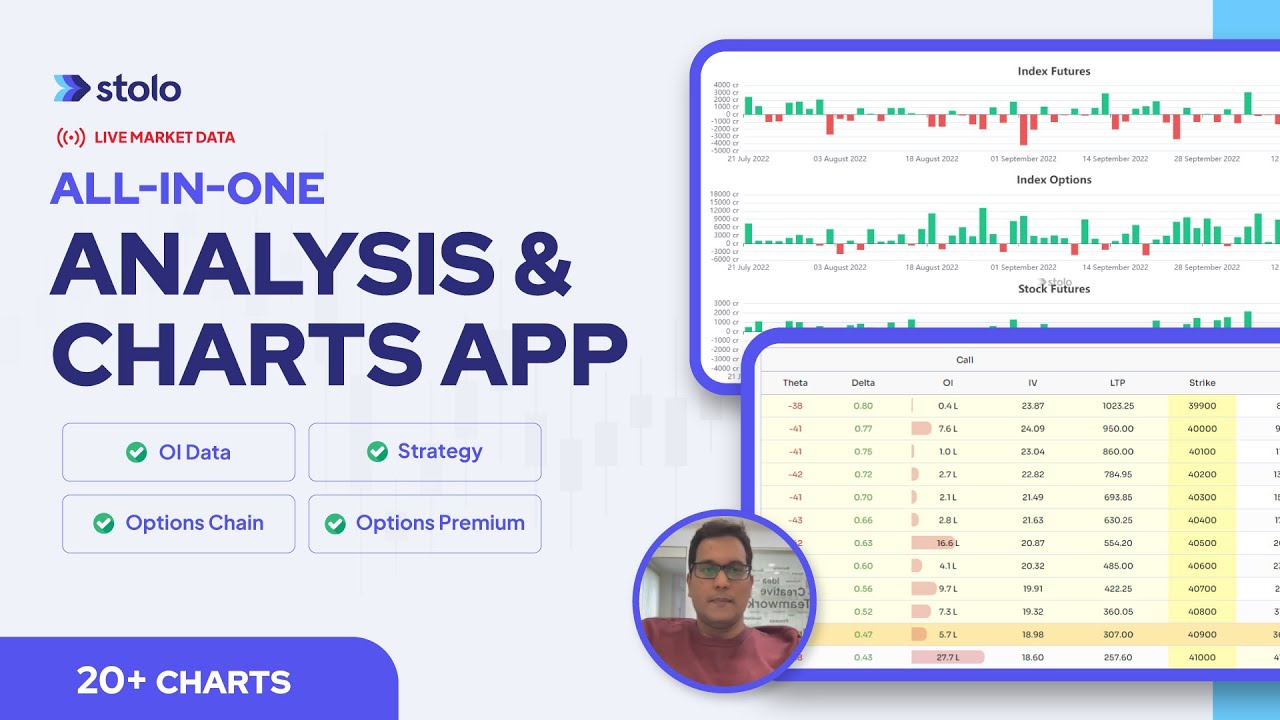
Stop guessing why you won or lost. Stolo's Trading Journal records all your F&O trades with P&L analysis, OI context, and custom tags, so every session becomes a lesson that compounds your edge over time.
Trader Voices
Every trade is a small bet on a dream, backed by risk and a decision you have to own. Stolo is built for traders who bring purpose and discipline to that decision, not just numbers.

My first impression of your site, "K.I.S.S."..... Simple yet effective...uncluttered and has all the ingredients a trader actually needs not the nonsensical ones... great job
These are unedited testimonials from traders in our Telegram community. Photos shown are AI-generated and used for representation only.

You have something unique in your platform that has changed my trading. I have used Quantsapp earlier didn't find it useful. I have tried opstra, sensibull etc.
These are unedited testimonials from traders in our Telegram community. Photos shown are AI-generated and used for representation only.

Dear Sir, I am really impressed with the user interface and multiple other facilities for option traders.
These are unedited testimonials from traders in our Telegram community. Photos shown are AI-generated and used for representation only.
Got a question or a feature you wish existed? Drop it in our Telegram community, the Stolo team is right there reading every message.