Trader Voices
Why Smart Traders Choose Stolo?
Every trade is a small bet on a dream, backed by risk and a decision you have to own. Stolo is built for traders who bring purpose and discipline to that decision, not just numbers.
Options Premium Decay refers to the natural decrease in the premium of an option over time as it nears its expiration. On Stolo, we help traders easily track and analyze this decay in real time, providing insights into both intrinsic and extrinsic value shifts. Whether you’re managing a short-term trade or a long-term strategy, understanding premium decay is essential to making informed decisions.
No credit card required · Trial Plan available · Setup in 3 minutes

Premium decay in options is invisible until it isn't. By the time most traders notice their position's value bleeding away, the good exit window has usually already closed.
Premium decay accelerates sharply in the final week before expiry. Traders who aren't tracking live Theta often ride long positions straight through that acceleration, watching their remaining time value collapse faster than they expected.
A multi-leg strategy can look profitable on a payoff diagram and still bleed daily if the net Theta is negative. Without decay visibility at the strategy level, you're trusting a static chart instead of what's actually happening in the market.
Two strikes at the same expiry can carry very different Theta profiles. Pick a strike without comparing decay rates against the alternatives, and you're leaving measurable premium on the table with every single trade.
Without live decay data, exit timing turns into a guess. Sellers exit too early and leave premium uncaptured. Buyers hold too long and watch their time value vanish before the underlying ever moves.
Premium decay in options is the daily erosion of an option's time value as it moves closer to expiry. Every option you buy or sell carries two components of value: intrinsic value (how far the strike sits in the money) and extrinsic, or time, value, which decays a little every day whether or not the underlying moves at all.
This isn't random decay. It's governed by Theta, the option Greek that measures how much premium an option loses per calendar day. Serious traders don't have the luxury of ignoring premium decay, since it's often the difference between a position that's working for you and one that's quietly draining capital in the background.
Track Decay Live on StoloOptions decay slowly in the early weeks of their life and steeply in the final days. An option losing 5 rupees a day in week one might lose 50 rupees a day in the final 48 hours. That's exactly why strategy decisions built on premium decay can't rely on a static payoff diagram alone.
Theta turns premium decay into a concrete rupee number per day. A short option with Theta of -15 earns roughly 15 rupees a day assuming nothing else moves. A long position with the same Theta costs you 15 rupees a day. Knowing your net Theta exposure in actual rupees, not abstractions, is how professional traders run their options book.
The intrinsic value of an in-the-money option is tied to the underlying price and doesn't erode with time at all. Only the extrinsic piece, the time value, is subject to decay. Once you know that split, you know exactly how much of the remaining premium is at risk from time alone versus how much depends on the underlying actually moving.
At-the-money options decay faster than out-of-the-money or deep in-the-money strikes, which makes them the most sensitive to the passage of time. That's part of why sellers building premium-collecting strategies usually target ATM or near-ATM strikes: the decay rate per rupee of risk works best there.
Real-time Theta monitoring, strike-level decay comparison, and strategy-aware time value tracking, built for structured options trading.

Watch options premiums erode in real time, strike by strike. You see exactly how much time value is bleeding out of each contract as the session runs, no guesswork and no estimates involved.

Compare premium decay across several strikes and expiries at once. Instantly see which ones are decaying fastest and which hold their value longer, so you pick the more favourable contract each time.

Look at premium decay for the whole strategy, not just one leg at a time. Whether you're running an iron condor, a straddle, or a butterfly, see how time is working for or against the full position.

Track live Theta values across your watchlist. Theta tells you precisely how much premium an option is shedding per day, so you know whether time is on your side before you place the trade.

Decay speeds up sharply in the final days before expiry. Stolo highlights that acceleration so sellers can ride the steepest part of the curve and buyers know to get out before the value collapse eats into what they've made.

Line several strikes up side by side and compare how fast each one is decaying. Picking the strike with the best balance of premium received against decay risk is a real edge for anyone running short option strategies.

See exactly how much of an option's price is intrinsic and how much is time premium. That split tells you how much decay potential is left and whether the premium is worth selling at the current level.

Use decay data to time exits with precision. When decay slows down unexpectedly, or speeds up ahead of schedule, Stolo flags it so you can act at the right moment instead of a session too late.
Stolo gives you detailed premium decay analysis on every individual option strike, across every expiry. Compare how fast different strikes are losing time value during the session and figure out which contracts offer the best decay profile for whatever you're trying to do.
Most traders lean on static payoff charts showing potential outcomes at expiry. Stolo shows you the live decay curve as it plays out, so your exit decisions are based on what's happening right now rather than an approximation from earlier in the day.
Start Your Trial
Inside Stolo's Strategy Builder, you get real-time premium decay for the entire strategy rather than individual legs viewed in isolation. Run an iron condor, straddle, strangle, or butterfly and watch time value erode across every leg at once. That tells you whether the strategy is actually generating positive decay or quietly bleeding value, and when it's time to adjust or exit before the market decides for you.
Managing a strategy with decay in view is what separates systematic premium sellers from traders who just hold positions and hope. Stolo puts that visibility in your hands from the moment you build the trade.
Start Your Trial
Theta is the most direct read on premium decay there is, it tells you exactly how much an option's price is set to erode with each passing day. On Stolo, you can watch live Theta values across your entire options watchlist, so you always know how time is treating every position you hold or are thinking about entering.
Watching Theta in real time is how you actually build decay-positive positions on purpose. When Theta is working in your favour, the numbers confirm it. When it's working against you, you see that early enough to act, not after a chunk of value has already quietly disappeared.
Monitor Theta Live
A practical five-step method for folding premium decay data into your options workflow, from picking the strategy to managing the exit, so time works for you systematically instead of by accident.
Start TrialBefore placing any options trade, pull up Stolo's Theta view and work out your net daily decay exposure in rupees. If you're selling, confirm the strategy carries positive net Theta, meaning time is paying you every day. If you're buying, know exactly how much decay you're absorbing daily and set yourself a clear time limit on the position.
Use Stolo's cross-strike comparison to see Theta across several strikes at once. Sellers want the strike offering the highest daily decay relative to the margin required. Buyers should look for strikes with low Theta, where the daily time cost of holding stays minimal while directional exposure stays high.
As the position develops, keep an eye on how the intrinsic-to-extrinsic ratio shifts. If you're short and intrinsic value starts rising (the strike moving in-the-money), your decay advantage is eroding and it's worth reassessing. If you're long, a shrinking extrinsic component tells you how much time value is left before the position becomes a pure directional bet.
Stolo's expiry countdown analysis shows you where you sit on the decay curve. In the final five days before expiry, decay speeds up considerably: sellers should be positioned to capture that stretch, while buyers need to weigh whether whatever time value is left justifies holding on. Moving before the acceleration peaks tends to produce better outcomes than reacting once it's already underway.
Decay data tells you about time. The option chain tells you about price and positioning. When Stolo shows decay hitting your target level on a short position, and the option chain confirms OI is reducing at that strike, you've got both time and positioning agreeing on the exit, which is a much stronger signal than either one on its own.
Most platforms hand you a static Theta figure and leave it there. Stolo shows you live decay across strikes, strategies, and expiries in one connected workflow. Here's the comparison.
| Capability | Stolo | Option Chain Tools | Broker Terminals | Generic Calculators |
|---|---|---|---|---|
| Real-time live Theta per strike | ||||
| Cross-strike decay rate comparison | ||||
| Strategy-level net Theta view | ||||
| Intrinsic vs extrinsic value split | ||||
| Expiry countdown acceleration view | ||||
| NSE-authorised real-time options data | ||||
| Decay data integrated into strategy builder |
Real-time strike-level data, strategy-aware decay tracking, and live Theta monitoring, all folded into a single workflow built for Indian F&O options traders.

Premium decay doesn't move in a straight line, it accelerates hard as expiry gets close. Stolo's real-time decay data shows exactly where you sit on that curve, so sellers can time exits to capture maximum decay and buyers can get out before value collapses. Timing driven by data instead of gut feel.

All options data on Stolo comes straight from NSE through authorised real-time feeds. Theta values, premiums, and decay figures are live and accurate, not delayed by seconds and not estimated. Act on a decay signal here and you're acting on the market's actual current state, not a stale snapshot.

Decay analysis isn't a separate screen you have to go hunting for. It's built directly into the Strategy Builder, so the moment you design a position, you see its decay profile right there. Build strategies that work with time instead of fighting it, from the moment you structure the trade.
Questions?
Direct answers to the most-searched questions about options time decay, Theta, and time value erosion in NSE F&O trading
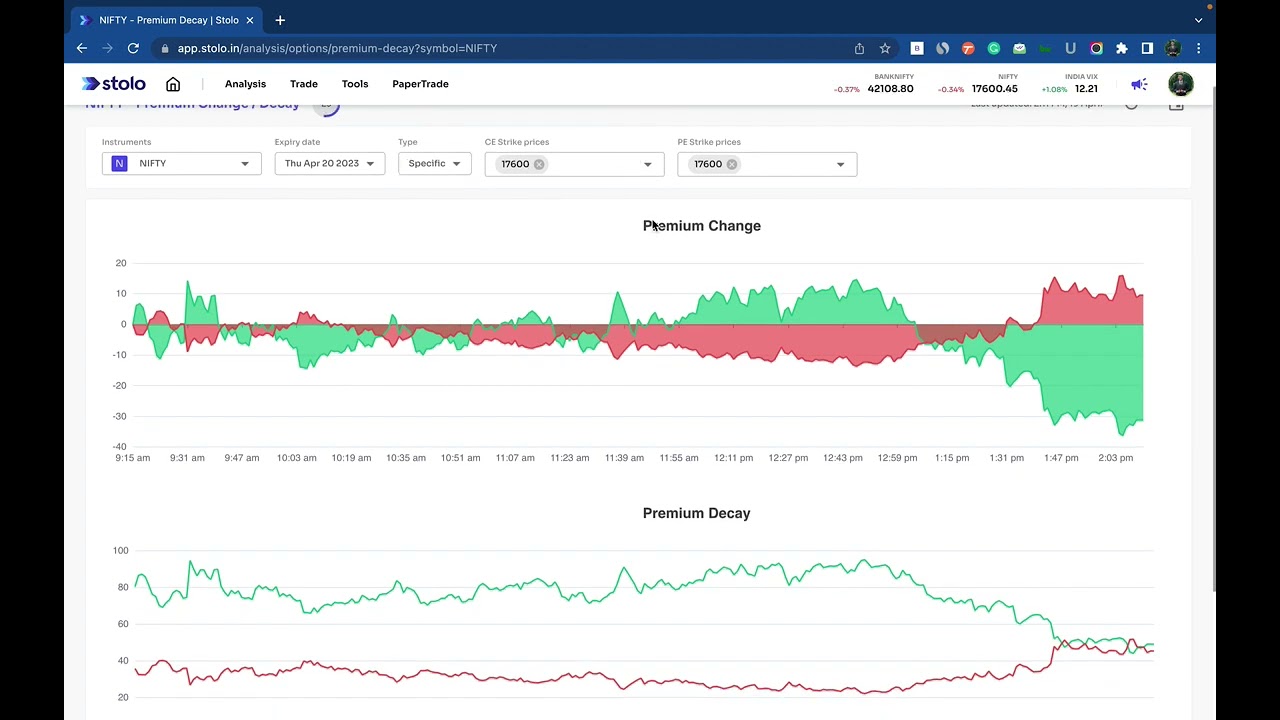
Stolo's Options Premium Decay tool gives you real-time visibility into how time value erodes across strikes, strategies, and expiries. Track live Theta, compare decay rates across Nifty and BankNifty strikes, monitor intrinsic versus extrinsic value, and manage the full strategy-level decay profile for every position you hold, all powered by NSE-authorised real-time data.
Trader Voices
Every trade is a small bet on a dream, backed by risk and a decision you have to own. Stolo is built for traders who bring purpose and discipline to that decision, not just numbers.

My first impression of your site, "K.I.S.S."..... Simple yet effective...uncluttered and has all the ingredients a trader actually needs not the nonsensical ones... great job
These are unedited testimonials from traders in our Telegram community. Photos shown are AI-generated and used for representation only.

You have something unique in your platform that has changed my trading. I have used Quantsapp earlier didn't find it useful. I have tried opstra, sensibull etc.
These are unedited testimonials from traders in our Telegram community. Photos shown are AI-generated and used for representation only.

Dear Sir, I am really impressed with the user interface and multiple other facilities for option traders.
These are unedited testimonials from traders in our Telegram community. Photos shown are AI-generated and used for representation only.
Got a question or a feature you wish existed? Drop it in our Telegram community, the Stolo team is right there reading every message.