Every trader makes mistakes. That is part of the learning curve. But some mistakes while using option chain analysis are avoidable and knowing them upfront can save you real money and unnecessary stress.
Options trading is a risk-reward game. If you understand what can go wrong before it happens, you are already ahead of most retail traders. This guide walks you through 8 of the most common mistakes while using option chain data, and how you can avoid them to trade with more clarity and confidence.
What are Option Chains?
An option chain is a complete list of all open option contracts for a specific stock or underlying asset. It shows the strike price, expiration date, and the current bid and ask prices for each contract.
Traders use option chains to evaluate which contracts to trade, assess potential risk and reward, and make more informed decisions about buying or selling options. But simply having access to an option chain is not enough. How you read and use that data is what makes the difference.
Most retail traders do not fail because they lack ambition. They fail because they lack clarity and proper tools.” — Stolo Brand Philosophy
If you are new to reading option chains, start with our guide on how to use an option chain before diving into this list.
8 Common Mistakes To Avoid When Using Option Chains
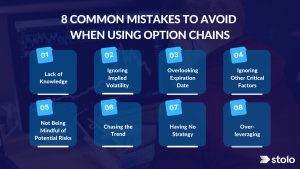
1. Lack of Knowledge
Starting without a solid foundation is one of the most dangerous mistakes while using option chain data. Before you trade options, you need to understand key concepts like strike price, expiration date, open interest, implied volatility, and the Greeks (Delta, Theta, Gamma, Vega).
Options trading rewards preparation. Traders who skip the fundamentals tend to misread the data in front of them, make impulsive entries, and exit too early or too late. A strong base of knowledge does not just help you interpret the option chain better, it gives you the confidence to trade with structure.
If you are still building that foundation, Stolo’s learning resources are a good place to start. The platform is built to make options education practical and actionable, not overwhelming.
2. Ignoring Implied Volatility
Implied volatility (IV) is a measure of how much the market expects an underlying asset to move over a given period. It is derived from the price of the options contracts themselves, not from historical price data.
When implied volatility is high, options are more expensive. When it is low, options are cheaper. Many traders focus only on the direction of the trade (bullish or bearish) and completely overlook IV which can result in buying expensive options right before volatility collapses, or selling cheap options just before a big move.
Ignoring implied volatility is one of the costliest mistakes while using option chains. Before entering a trade, always check where IV stands relative to its historical range. A trade that looks good on paper can turn unprofitable purely because of IV movement, even if the underlying moves in the right direction.
Stolo’s options analytics tools surface implied volatility data clearly, so you are never making decisions blind.
3. Overlooking the Expiration Date
The expiration date is not just a deadline. It actively shapes how the option is priced and how sensitive it is to market movement.
Options that are close to expiration experience accelerated time decay (Theta), meaning they lose value faster with each passing day. A short-dated option also becomes more sensitive to small movements in the underlying stock, which can work for you or against you depending on your position.
Many traders pick expiration dates carelessly either too short and get crushed by time decay, or too far out and end up holding a position longer than intended. When you read an option chain, the expiration column should be one of the first things you evaluate against your trade thesis and holding period.
4. Ignoring Other Critical Factors That Affect Option Prices
An option’s price is not driven by a single variable. Multiple factors move simultaneously:
- Interest rates can affect the pricing of longer-dated options
- Dividends impact call and put premiums for equity options
- Economic events (earnings, RBI policy, global macro data) can cause sudden spikes in implied volatility
A common mistake while using option chain analysis is treating the chain as a standalone source of truth. It is a snapshot of market sentiment at a point in time. Experienced traders cross-reference the chain with economic calendars, earnings schedules, and sector-level events before entering positions.
Always zoom out before you zoom in.
Put this knowledge to work. Stolo gives you real-time options analytics, live Greek values, OI charts, and strategy builders — built for Indian retail traders.
Try Stolo5. Not Being Mindful of Potential Risks
Options can expire worthless. This is not a worst-case scenario it is a routine outcome for a large portion of retail options trades.
One of the most under-appreciated mistakes while using option chains is entering a trade without clearly defining how much you are willing to lose. Risk management is not a secondary consideration. It is the foundation of every trade.
Before placing a trade:
- Know your maximum loss
- Set a stop-loss or exit condition in advance
- Size your position relative to your overall capital
According to SEBI’s 2024 study on retail F&O participation, a significant majority of individual traders in the futures and options segment incurred losses over the studied period. The common thread across most of those losses was poor risk management, not bad market calls.
Stolo is built around this exact idea. The name itself comes from “Stop Loss” — a reminder that protecting capital is always the priority.
6. Chasing the Trend
When a particular stock or contract is generating buzz in news, on social media, or in trading communities it can be tempting to follow the crowd. This is one of the more emotionally driven mistakes while using option chain data.
Option prices are influenced by far more than just the direction of the underlying stock. IV, time to expiry, open interest patterns, and liquidity all shape the risk profile of any given contract. A contract that looks like a “sure thing” based on price movement alone may already have elevated IV priced in, meaning you are buying at peak premium.
Do your own analysis. Look at the open interest distribution across strikes, track changes in IV, and understand what the chain is telling you not what social media sentiment is telling you. For a structured way to approach this, read our article on the benefits and limitations of using option chains as a trading tool
7. Trading Without a Strategy
Walking into an options trade without a defined strategy is one of the most consistent mistakes new traders make. It is not just about knowing whether you are bullish or bearish. A proper options strategy defines:
- Your entry criteria
- Your exit criteria (both profit and loss)
- The specific contracts you will use (strikes, expiry)
- How this trade fits your broader risk exposure
When you have no strategy, you are reacting to the market rather than engaging with it. This leads to impulsive trades, emotional exits, and a pattern of inconsistency that is hard to break.
A trading journal is one of the most underused tools among retail traders. Documenting your strategy before each trade, and reviewing outcomes afterward, builds the kind of self-awareness that actually improves performance over time.
Stolo’s strategy builder is designed to help traders construct and evaluate options strategies before entering the market. If you want to explore what is available, our guide on the benefits of using a strategy builder for options trading is a good starting point.
8. Over-Leveraging
Leverage is what makes options appealing a small move in the underlying can produce significant returns on a well-placed options trade. But the same leverage that amplifies gains also amplifies losses.
Over-leveraging is one of the most financially damaging mistakes while using option chains because it can wipe out a trading account in a single bad session. Many retail traders use margin to take on positions much larger than their actual risk tolerance, often driven by overconfidence after a few winning trades.
The rule is straightforward: only trade with capital you can afford to lose. Do not use margin unless you fully understand the downside exposure. And never let a single trade risk a disproportionate share of your account.
Discipline around position sizing is what separates consistent traders from those who blow up their accounts chasing returns.
Conclusion
Option chains are powerful but only when you use them correctly. The mistakes while using option chain analysis covered in this guide are not rare edge cases. They are patterns that show up repeatedly, especially among traders who are still developing their discipline and process.
Here is a quick summary of what to keep in mind:
1. Build your knowledge before you trade
2. Always check implied volatility, not just direction
3. Choose expiration dates deliberately
4. Factor in all variables that move option prices
5. Define your risk before every trade
6. Avoid trading on trend or sentiment alone
7. Enter every trade with a clear, written strategy
8. Manage leverage carefully and consistently
The goal is not to avoid trading. The goal is to trade with more structure, more clarity, and less emotional noise. That is exactly what Stolo is built for.
Frequently Asked Questions
What is the most common mistake while using option chain data?
The most common mistake is ignoring implied volatility. Traders focus on price direction but overlook how IV affects option premiums, often buying expensive options right before volatility drops.
Can option chains predict stock price movement?
Not directly. Option chains reflect market sentiment and the pricing of risk at a given moment. They are analytical inputs, not predictions. Always use them alongside other tools like technical analysis and fundamental research.
How do I avoid over-leveraging in options trading?
Set a clear rule for the maximum percentage of your total capital you will risk on any single trade. Most disciplined traders keep single-trade risk between 1-3% of total capital. Never use margin unless you have a clear exit plan.
Why is expiration date important in options trading?
The expiration date affects time decay (Theta) and the option’s sensitivity to price movement. Options close to expiry lose value faster and become more volatile. Choosing the wrong expiry relative to your trade thesis is a common and costly error.
How does Stolo help traders avoid these mistakes?
Stolo provides real-time options analytics, implied volatility tracking, strategy building tools, and execution workflows — all designed to help retail traders make data-backed decisions. The platform is built to reduce emotional trading and bring structure to every stage of the trading process.
Is options trading suitable for beginners?
Options trading has a steep learning curve and carries significant risk. Beginners should focus on building foundational knowledge, start with small positions, and use a platform that supports structured learning. Stolo’s educational resources are designed specifically for retail traders at every stage.


