Max Pain in Options Trading, Explained
Price often drifts toward one particular strike as expiry approaches. That strike is usually the max pain level: the point where option buyers lose the most and writers lose the least. Stolo computes it live from the whole option chain and shows how it shifts through the day, so you can read the expiry bias instead of guessing at it.
The problem it solves
Every trader hears about max pain, few use it well. The calculation is tedious to do by hand and it changes all session as open interest moves. Without a live chart you cannot see where max pain is, when it starts shifting, or how strong the OI around it is. Stolo does the maths on every update and plots the result against the OI distribution.
The concept
- Options are a zero-sum transfer. Whatever buyers lose at expiry, writers gain.
- Writers are the bigger force. Institutions and market makers write most of the open options and hedge their books. They have both the incentive and, at the margin, the ability to nudge price toward the least-cost settlement.
- Max pain is that least-cost strike. Sum the payout of all open calls and puts at each possible expiry price. The strike with the smallest total is max pain.
- The pull is strongest when nothing else is happening. On a rangebound expiry with no catalyst, price often settles within a strike or two of max pain. A trend or an event overrides it.
Key terms explained
| Term | What it means |
|---|---|
| Max pain strike | The expiry price at which total open option value is lowest. |
| Option writer | The seller of an option, who profits when it expires worthless. |
| Pin | Price settling at or very close to a strike at expiry. |
| Call wall / put wall | The strikes with the largest call and put OI. |
| Expiry bias | The tendency for price to move toward max pain into the close. |
A worked example
It is NIFTY weekly expiry. At 09:30 the max pain chart shows max pain at 22,000, with price at 22,080. The heaviest call OI is at 22,100, the heaviest put OI at 22,000.
- Through the morning price chops between 22,040 and 22,110 with no trend.
- By 13:30 fresh call writing has appeared at 22,100 and put writing at 22,000 has grown. Max pain holds at 22,000.
- In the last hour price grinds down toward 22,020 and closes at 22,010.
The pin held. A trader who sold the 22,000 straddle at midday, seeing the flat price, the OI walls straddling max pain and no event on the calendar, collected the decay into the close.
How to use it in Stolo
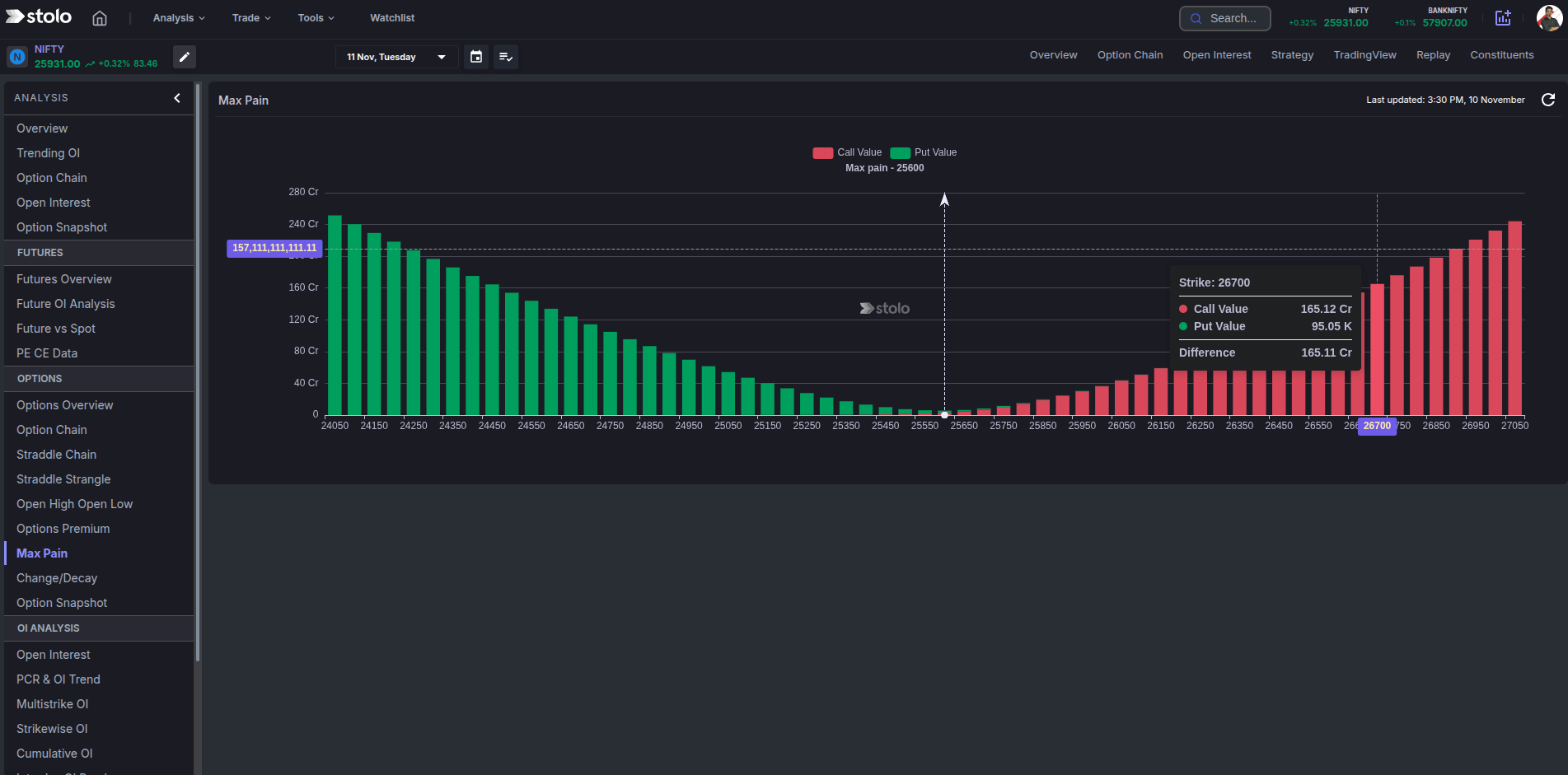
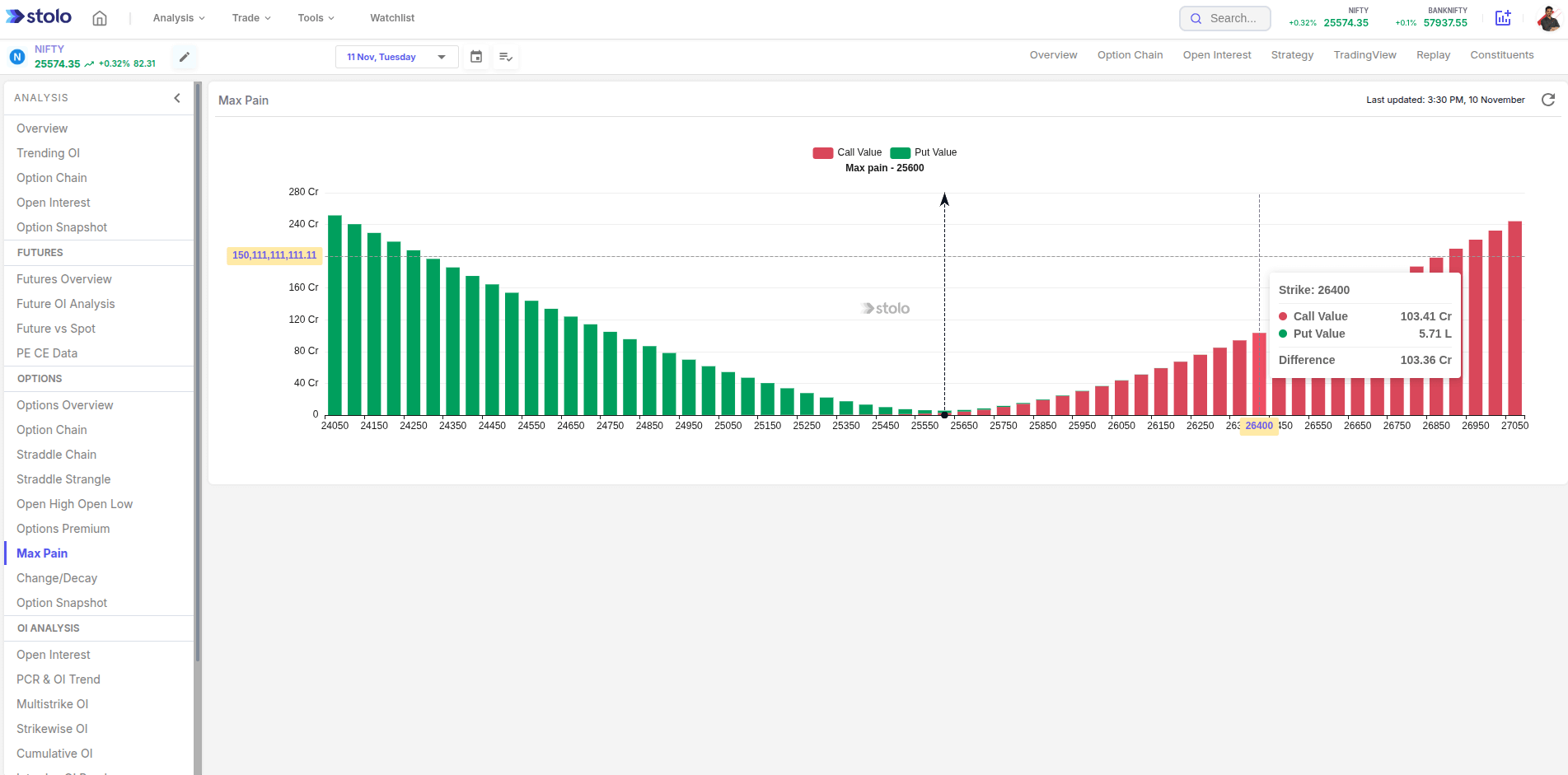
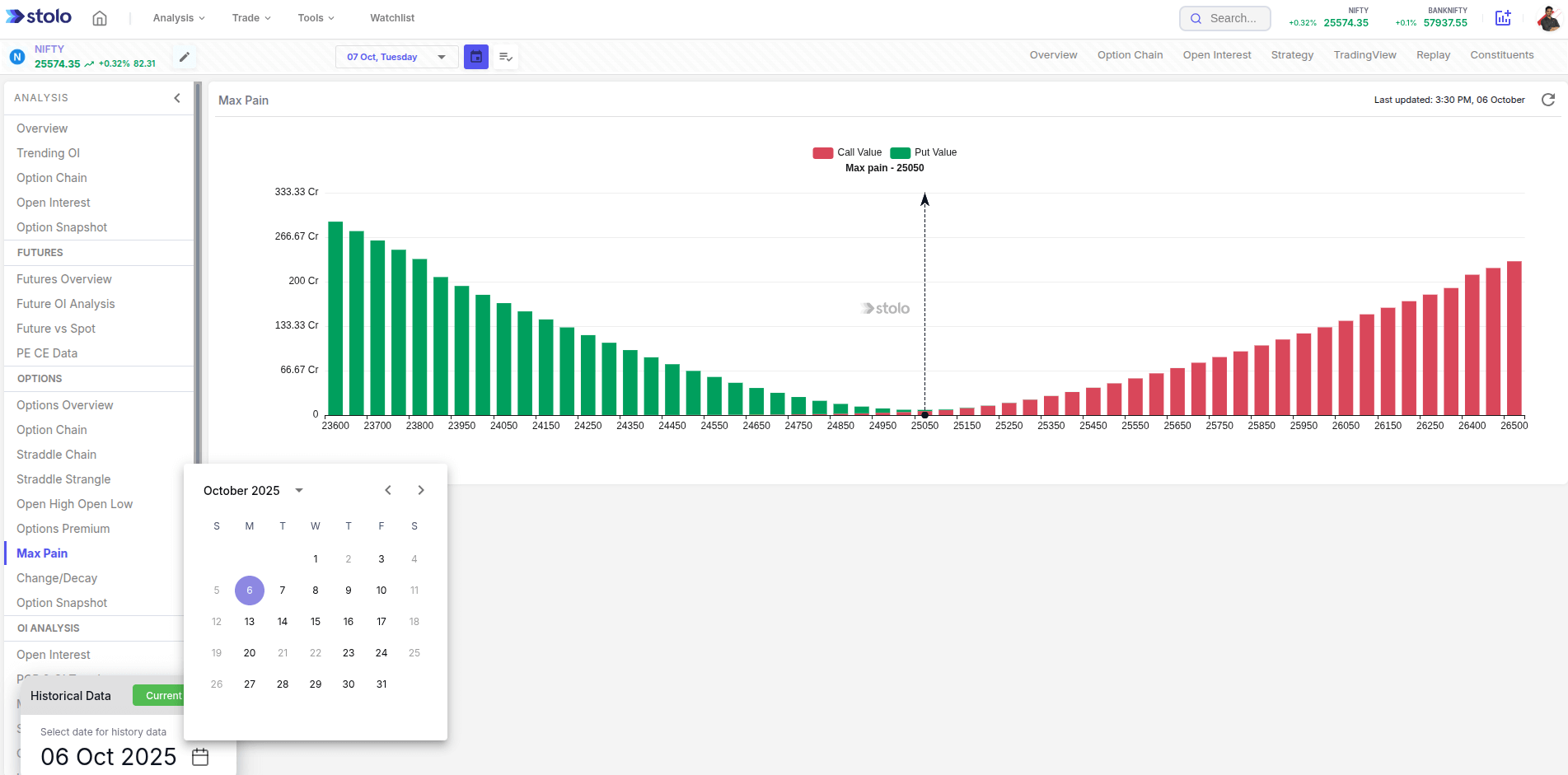
- Open Analysis, then Options, then Max Pain.
- Choose the instrument and the expiry.
- Read the max pain strike against the current price and the OI distribution plotted across strikes.
- Watch the strike shift through the day. A move up means fresh call writing higher; a move down means put writing lower.
- Give it weight only when max pain sits between the OI walls and there is no strong trend or event.
- Select a past expiry to see how the level evolved and where price actually settled.
Max pain is a bias, not a signal. Stolo does not place trades. Use it as context for an expiry-day view, then execute through the option chain or your connected broker.
How traders use it
- Rangebound expiry sell. A short straddle or iron fly centred on the max pain strike, into the last few hours.
- Directional target. Use max pain as the level a move is likely to gravitate toward.
- Late fade. Price that has run well past max pain in the last hour of a quiet expiry is a fade candidate back toward it.
- Confirmation. A max pain strike that agrees with the OI walls and the PCR read strengthens the whole picture.
Live mode and history mode
Live mode recomputes max pain on every OI update and plots its intraday path. History mode shows how max pain moved through a past expiry week and where the instrument actually closed.
Frequently asked questions
What is max pain in options trading?
How is max pain calculated?
Does price always expire at max pain?
Why does the max pain strike shift during the day?
How do I use max pain with the option chain?
Is max pain useful before expiry week?
Does Stolo show historical max pain?
Does max pain work for stocks or only indices?
How do traders act on max pain?
Which plan includes the max pain chart?
See the expiry magnet before it pulls
Open Stolo's Max Pain chart to track the least-pain strike and its intraday shift for any F&O instrument.
Start with a Flexi Trial from ₹199