Straddle Chain: Strike-wise Straddle Premium and OI
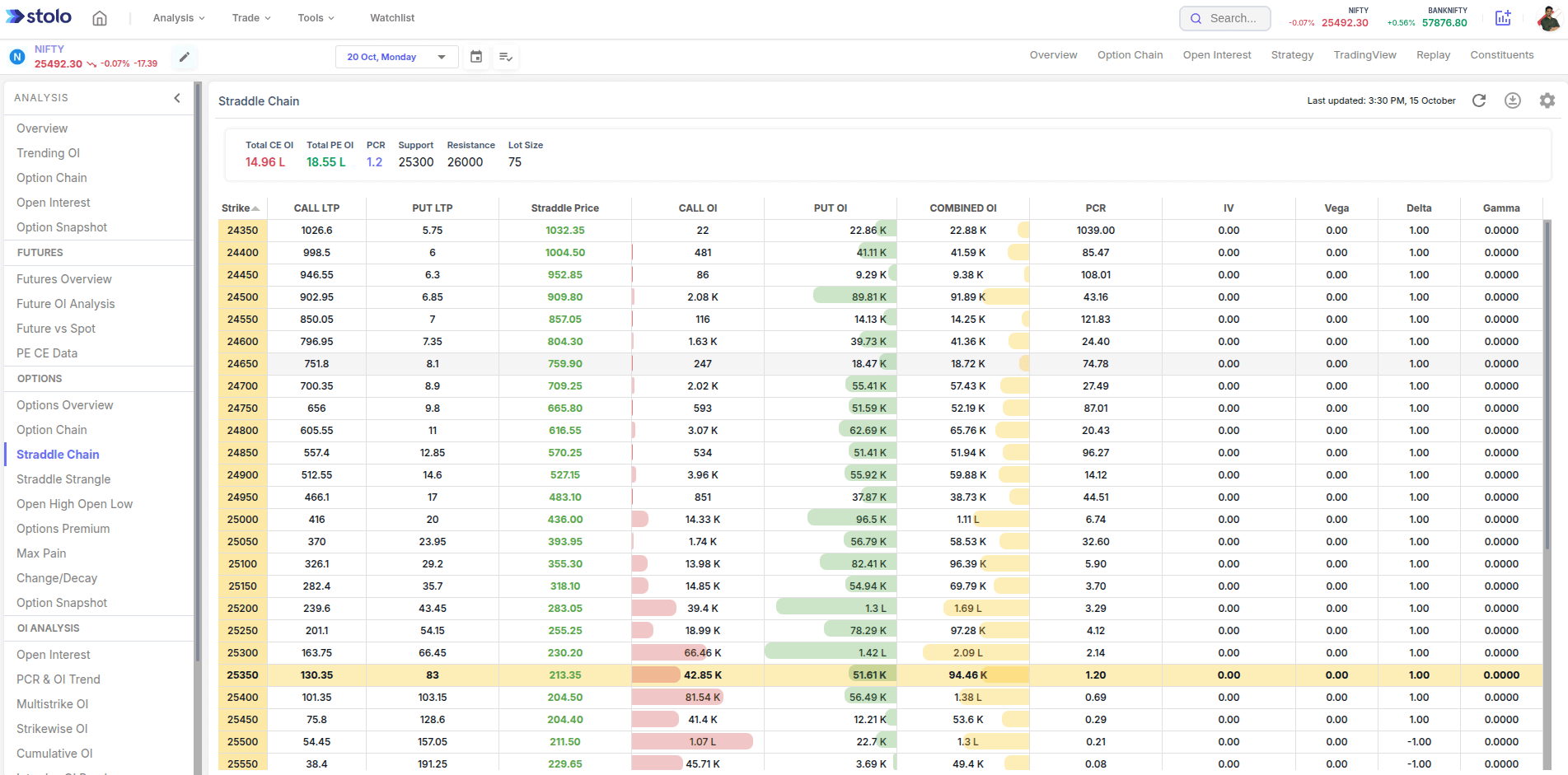
The straddle chain in Stolo is the option chain rearranged around the combined premium. For every strike of an expiry it shows the straddle price, the call plus the put, along with the call and put LTP, the call, put and combined OI, and PCR. It is the fastest way to read the implied range and pick a strike to sell or build a neutral strategy around.
The problem it solves
To read what the market expects, most traders add call and put premiums off the option chain by hand, strike by strike. That is slow and it is easy to lose the pattern. The straddle chain does the addition for every strike and lays it out as one table, so the cheapest straddle, the ATM premium and the OI concentration are all in view at once.
The concept
- The straddle is a pure volatility position. Its premium does not care about direction, only how far price moves.
- The ATM straddle prices the move. Its premium in points is roughly the one standard deviation move expected by expiry.
- The lowest straddle marks the centre. The strike with the smallest straddle premium is where the market sees the least expected movement, usually near the current price.
- OI shows who is on the other side. The combined OI and PCR columns tell you where writers are concentrated, which is where a short straddle has company and support.
Key terms explained
| Term | What it means |
|---|---|
| Straddle price | Call premium plus put premium at the same strike. |
| ATM straddle | The straddle at the strike nearest the current price. Its premium is the expected move. |
| Combined OI | Call OI plus put OI at a strike. |
| PCR | Put OI divided by call OI at that strike, or across the chain. |
| Implied range | The band around price implied by the ATM straddle premium. |
| Iron fly | Selling the ATM straddle and buying wings for defined risk. |
A worked example
NIFTY is at 22,000, weekly expiry in two days. In the straddle chain:
- 22,000 straddle: 130. That is the expected move, so the implied range is 21,870 to 22,130.
- 21,900 straddle: 145; 22,100 straddle: 150. Both higher, as expected away from the money.
- Combined OI is heaviest at the 22,000 and 22,100 strikes, and PCR across the chain is 1.2.
A seller reads this as a market expecting a quiet expiry centred on 22,000, with writer support at 22,000 and 22,100. Selling the 22,000 straddle for 130, or an iron fly with wings at 21,800 and 22,200, fits the picture. A buyer who expects a bigger move needs price outside 21,870 to 22,130 to profit on the straddle and can judge from history whether that is likely.
How to use it in Stolo

- Open Analysis, then Options, then Straddle Chain.
- Choose the instrument and the expiry.
- Read the straddle price column. The ATM value is the expected move; the lowest value marks the centre of the range.
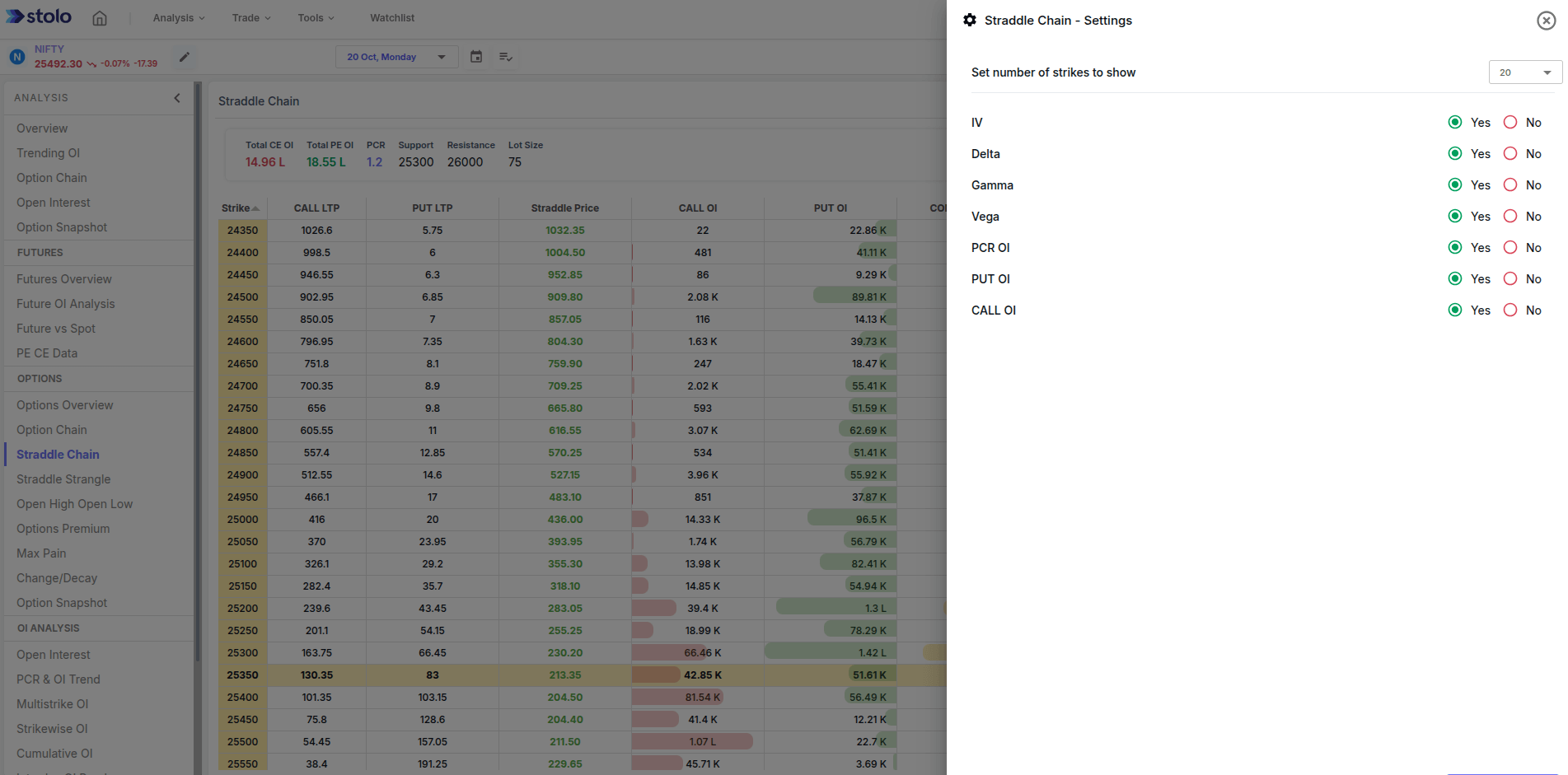
- Add the combined OI and PCR columns from settings to see where writers sit.
- Switch expiries to compare weekly and monthly implied moves.
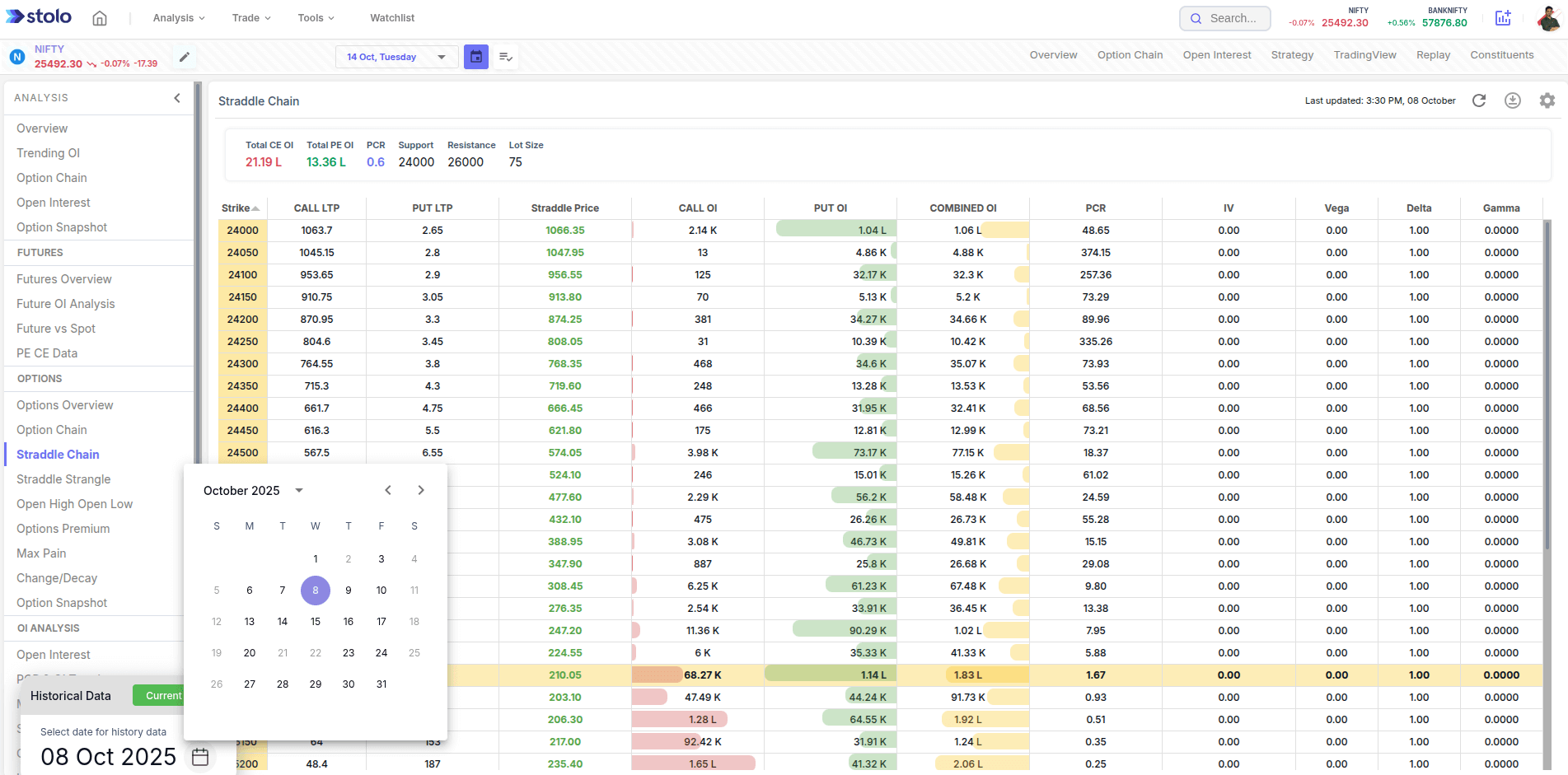
- Use the download icon to export as CSV, and the calendar icon to load a past date.
Stolo does not place trades. Use the straddle chain to judge the implied range and pick a strike, then execute the straddle or iron fly through the option chain or your connected broker.
How traders use it
- Strike selection for sellers. Pick the strike whose straddle is richest relative to the likely range.
- Neutral strategy setup. Build an iron fly or short straddle around the lowest-premium strike.
- Expected move for buyers. Use the ATM straddle premium as the move a long straddle has to beat.
- Term structure read. Compare the weekly and monthly straddle to see how the market prices near versus longer-term volatility.
Live mode and history mode
Live mode updates the straddle chain through the session. History mode loads it for a past date, so you can study how the implied range looked ahead of a previous expiry or event and calibrate what is normal.
Frequently asked questions
What is the straddle chain?
What does the straddle premium at a strike tell me?
How is the straddle chain different from the straddle and strangle chart?
Can I compare expiries in the straddle chain?
Which columns can I show in the straddle chain?
Can I export the straddle chain data?
Does the straddle chain update live?
Can I load a historical straddle chain?
How do traders use the straddle chain?
Which plan includes the straddle chain?
Read the implied range at every strike
Open Stolo's Straddle Chain to see the combined call and put premium, OI and PCR across the strikes of any F&O expiry.
Start with a Flexi Trial from ₹199