Strikewise OI Analysis for a Single Option Strike
Strikewise OI analysis in Stolo is the close-up. It takes one option strike and charts its call open interest, its put open interest and the price of the underlying together through the session, so you can see exactly how committed the writers at that level are and whether they are staying or leaving.
The problem it solves
Once you have identified a level that matters, a round-number strike acting as support, the max pain strike, the strike with the heaviest OI, you want to watch that one level closely without the noise of the whole chain. Strikewise OI gives you a dedicated chart for it, so a change in conviction at that strike is immediately visible.
The concept
- A strike is a battle between a buyer and a writer. OI at the strike is the size of that battle.
- Call OI and put OI at the same strike mean opposite things. Heavy call OI defends the strike from above as resistance; heavy put OI defends it from below as support.
- The change is the tell. Growing OI means the writers are adding conviction. Unwinding OI means they are stepping away, and the level is more likely to give.
- Price against OI completes it. OI up with price moving away from the strike is defence. OI down with price approaching the strike is capitulation.
Key terms explained
| Term | What it means |
|---|---|
| Strike | The single price level you are analysing. |
| Call OI at strike | Open interest in that strike's call, defends the level as resistance. |
| Put OI at strike | Open interest in that strike's put, defends the level as support. |
| Change in OI | The move in OI at the strike over the chosen interval. |
| Defence | OI growing as price moves away from the strike. |
| Capitulation | OI unwinding as price approaches the strike. |
A worked example
NIFTY is at 22,080 and you are watching the 22,000 strike as support, having taken a long at 22,090.
- Through the morning, 22,000 PE OI is large and grew a little on any dip toward 22,020. Put writers are defending 22,000.
- At 13:15 NIFTY drops to 22,030 and the 22,000 PE OI falls 15 percent in ten minutes. The put writers are covering.
The read: the support is being abandoned. Your stop just below 22,000 is now much more likely to be hit, so you tighten it to 22,020 or exit, rather than waiting for the level to break.
How to use it in Stolo
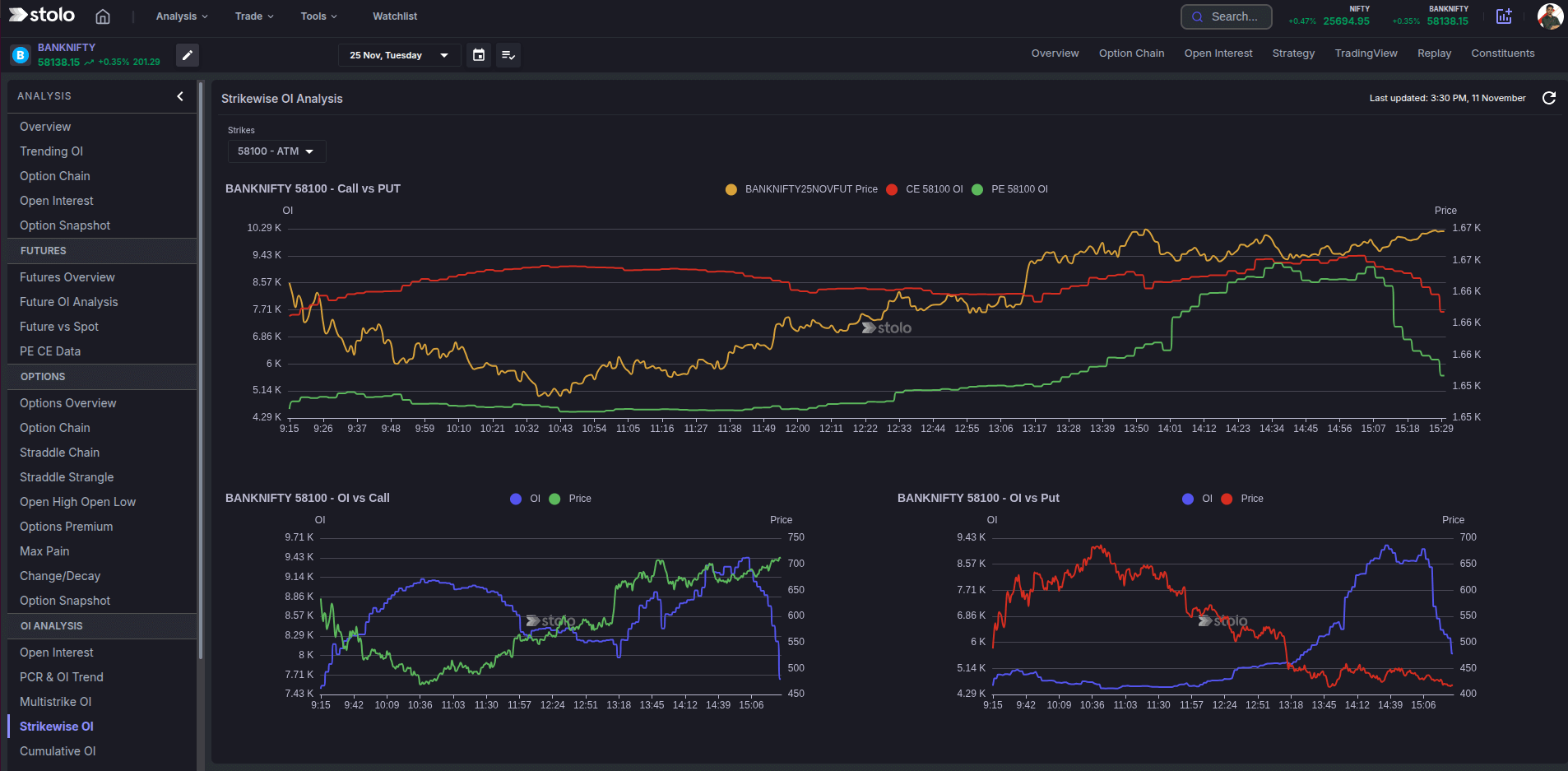
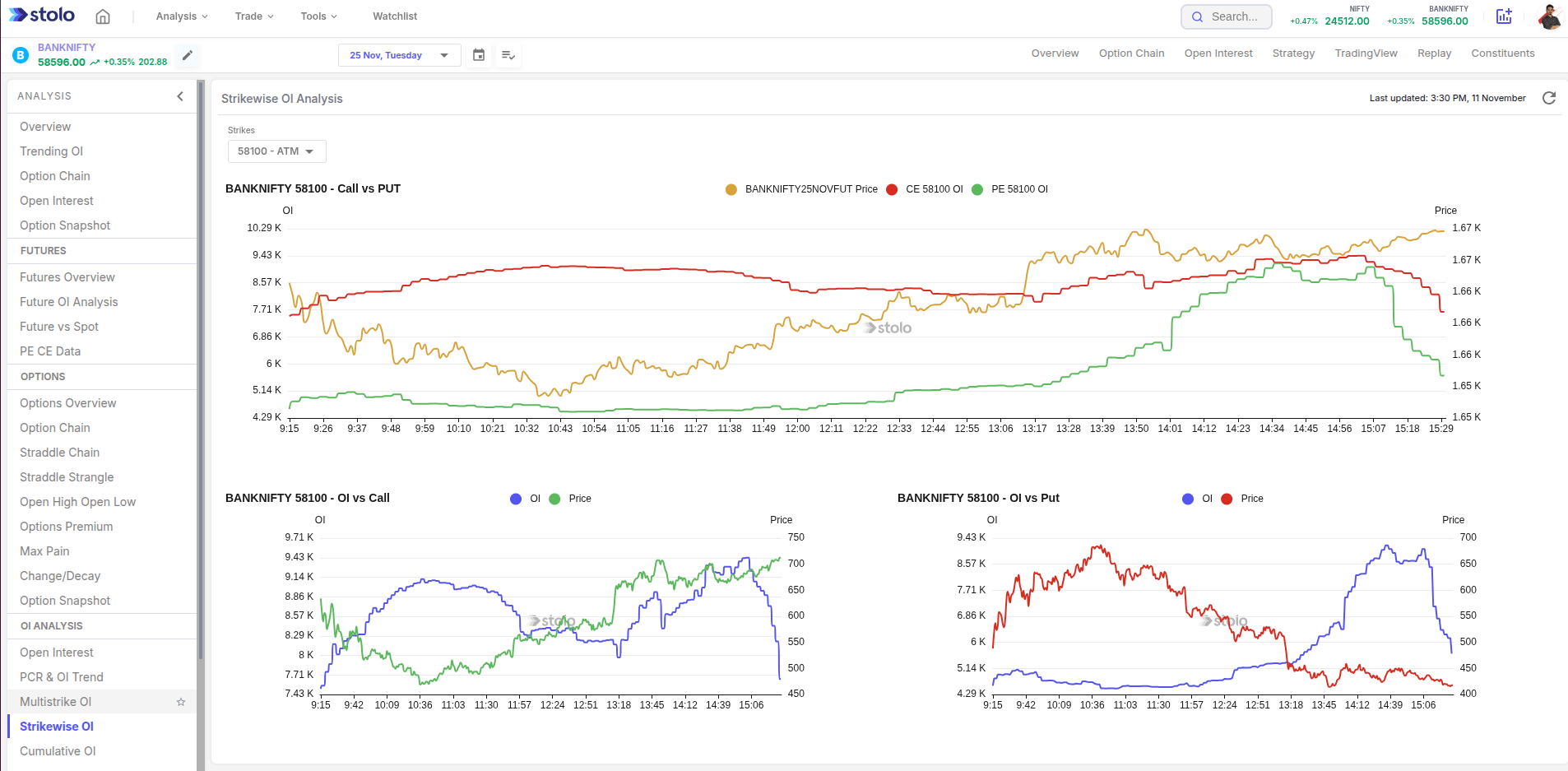
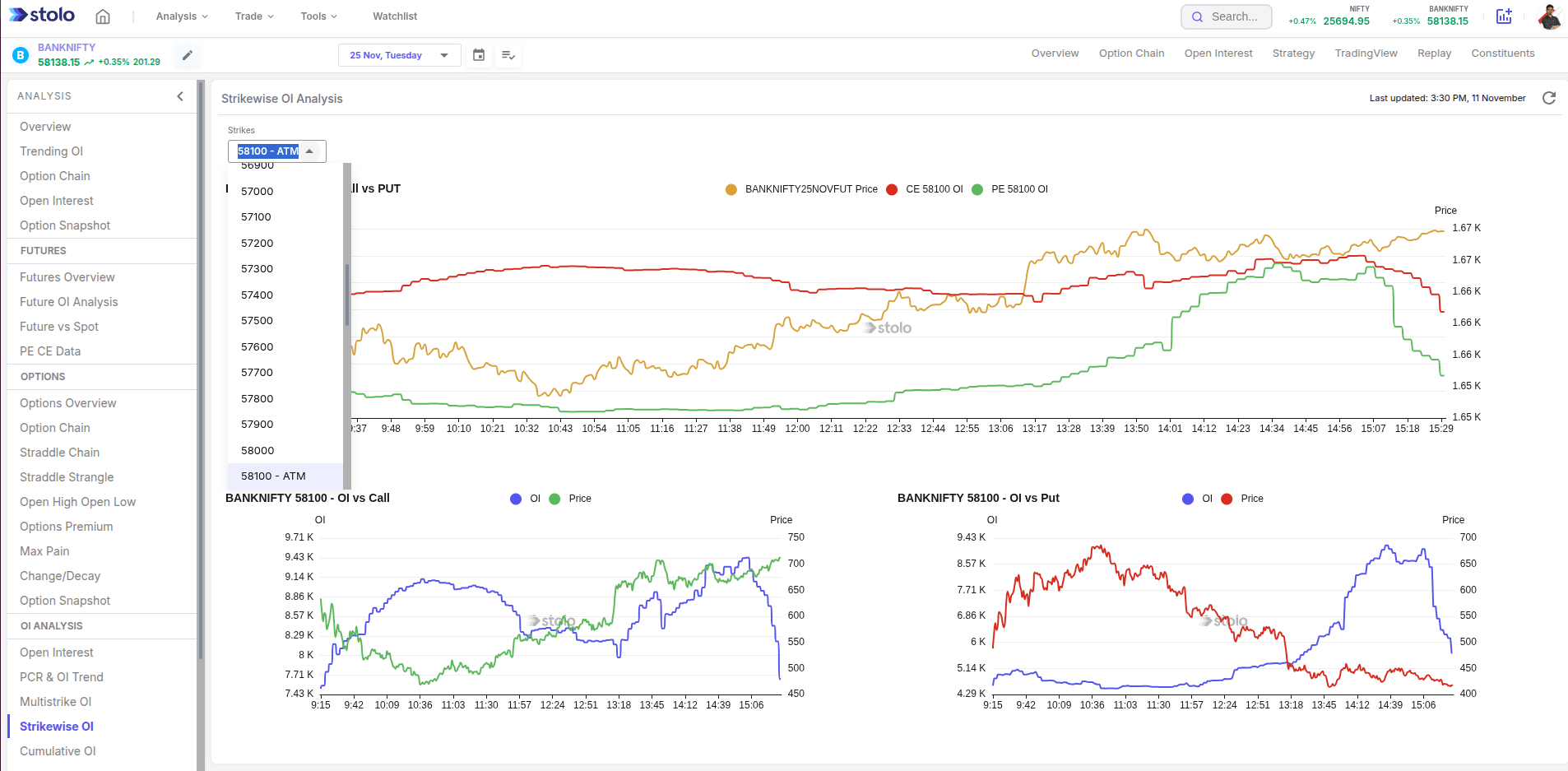
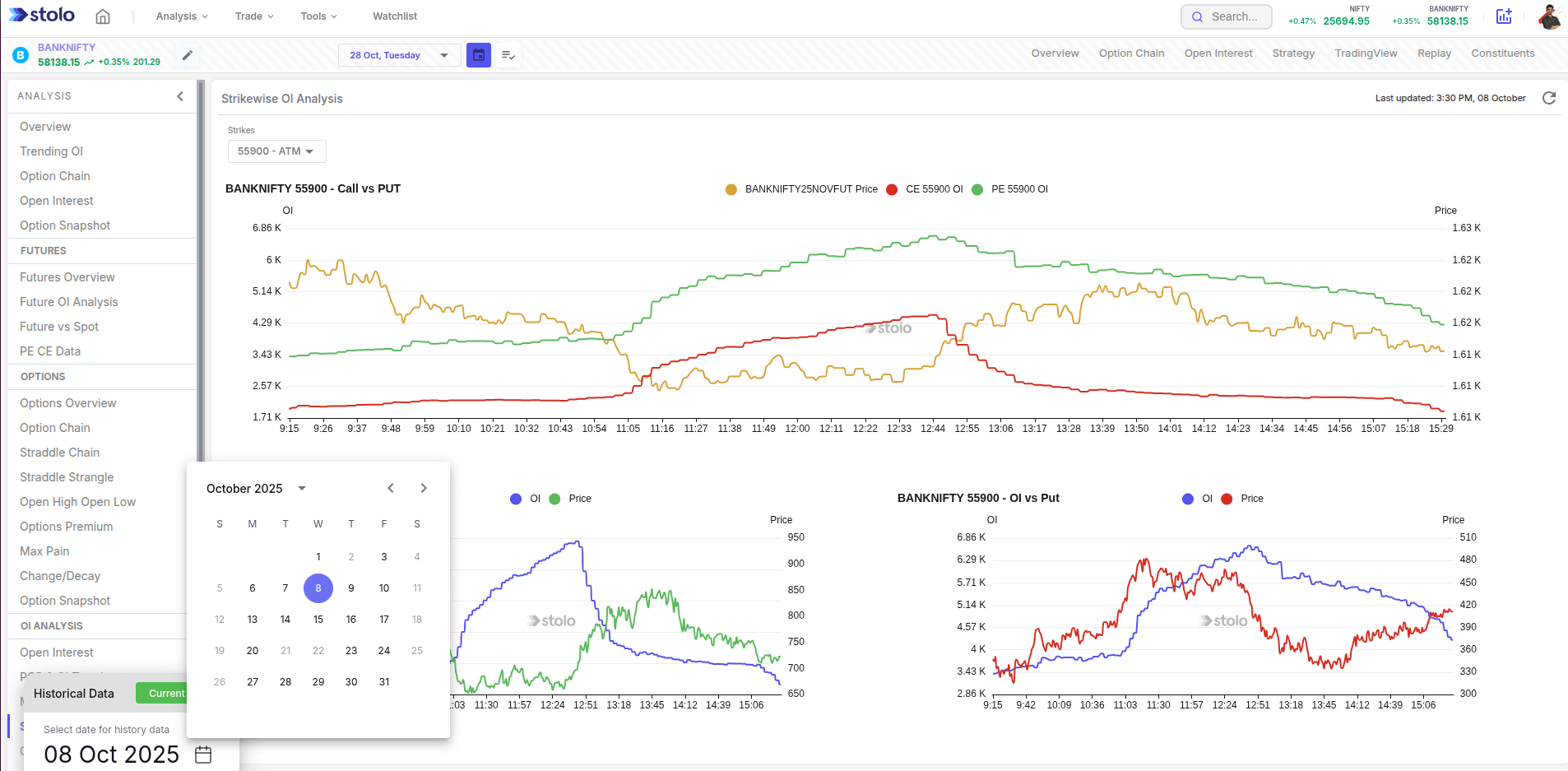
- Open Analysis, then Options, then Strikewise OI Analysis.
- Choose the instrument and expiry.
- Select the strike you want to watch.
- Set the time interval.
- Read call OI, put OI and price together: growing OI as price moves away is defence; unwinding OI as price approaches is capitulation.
- Load a past date to see how the same strike behaved in a previous session.
Pick the strike from the full option chain or the open interest view first. Strikewise is for watching a level you have already decided matters, not for finding it.
How traders use it
- Stop placement. Keep a stop just beyond a strike only while the OI defending it is stable or growing.
- Support and resistance confirmation. A level is real when the OI at it grows on tests, not just because it is a round number.
- Break anticipation. Fast unwinding at a defended strike is an early warning that the level will break.
- Expiry pin watch. On expiry day, watch the strike nearest price; heavy stable OI on both sides points to a pin there.
Live mode and history mode
Live mode streams the chosen strike through the session. History mode redraws it for a past date, so you can study how a level was defended or lost and recognise the pattern when you next trade around it.
Frequently asked questions
What is strikewise OI analysis?
When should I use strikewise OI instead of the full option chain?
What does it mean when call OI at a strike rises while price falls?
What does the call versus put OI comparison at one strike tell me?
Can I change the time interval?
Does strikewise OI work on stock options?
Can I view a past session?
How does this help with a stop loss?
Which plan includes strikewise OI analysis?
How is strikewise OI different from multistrike OI?
Watch the one strike that matters
Open Stolo's Strikewise OI Analysis to track call OI, put OI and price for a single option strike on any F&O instrument.
Start with a Flexi Trial from ₹199