Intraday OI Breakup: OI Change by Time and Strike
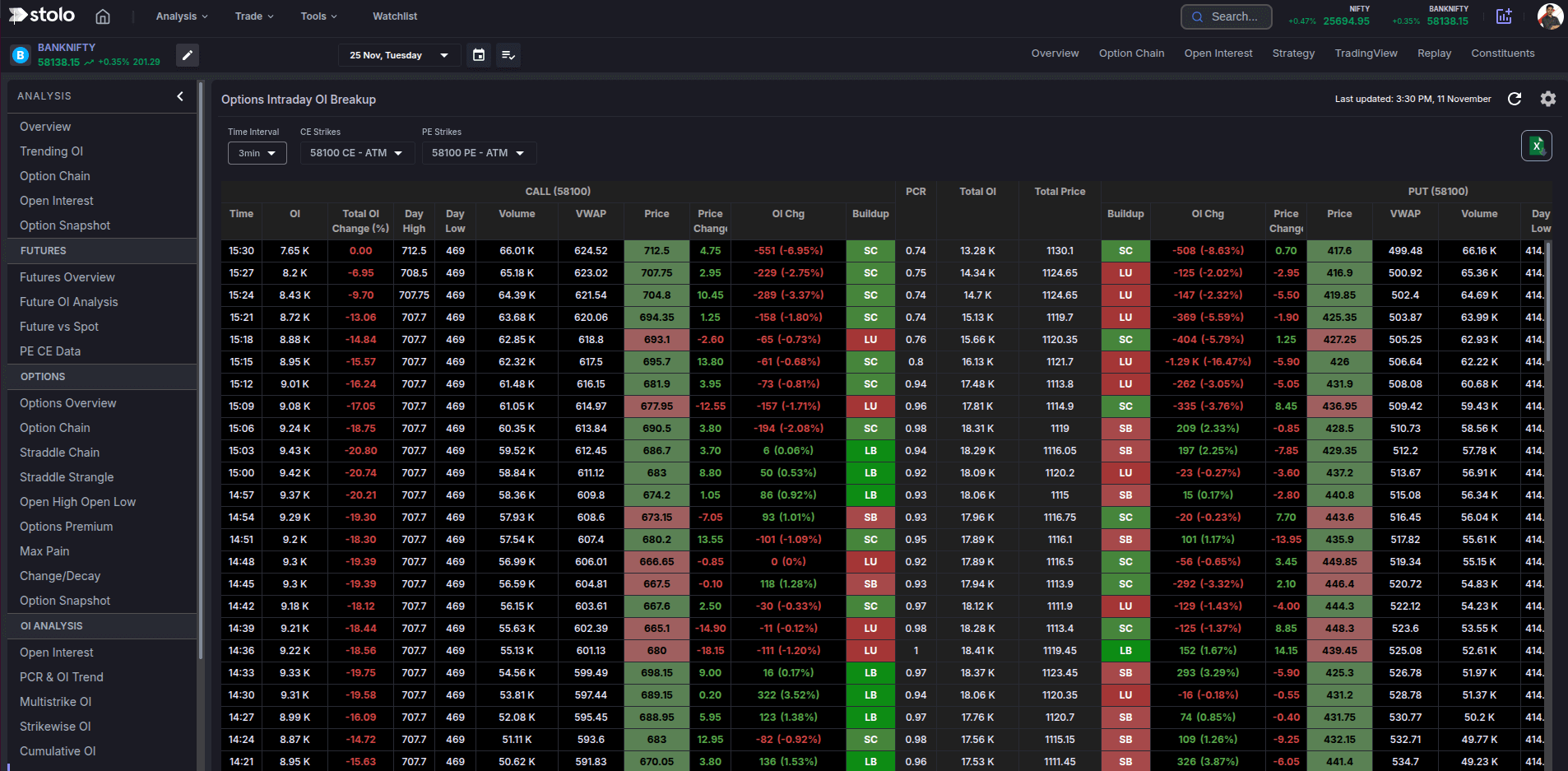
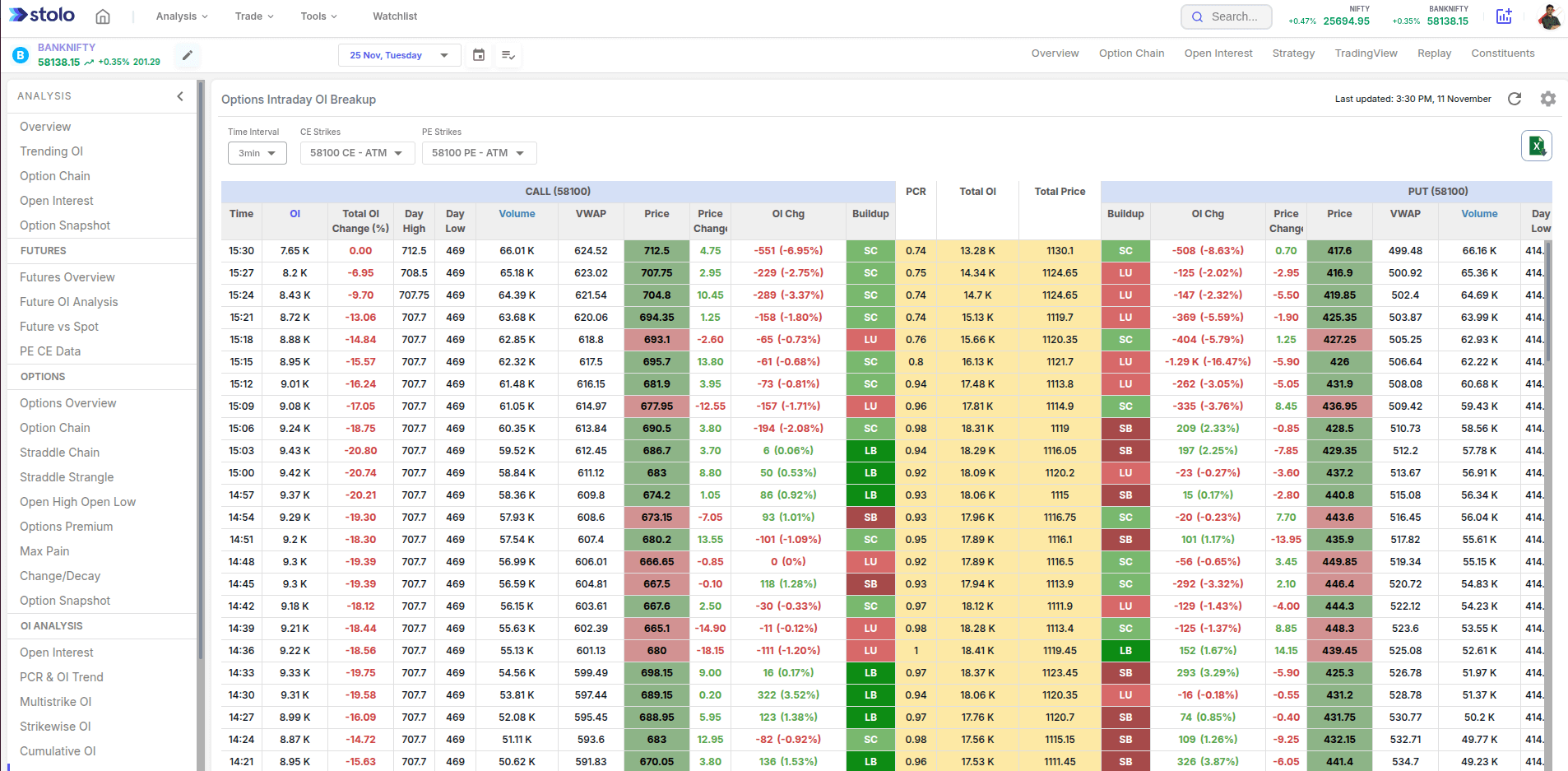
The intraday OI breakup in Stolo splits the day into time buckets and shows, for a chosen call and put strike, how open interest changed in each one, alongside price, volume, VWAP and the buildup type. A single end-of-day OI figure tells you what happened; this table tells you when it happened, which is what you need to time an entry.
Options Intraday OI Breakup in Stolo
The problem it solves
OI added at 9:20 on a gap open and OI added at 14:00 in a steady trend look identical in the daily number, but they mean different things. The first often reverses; the second is conviction. Without a time breakdown you cannot tell them apart. This table shows the OI change bucket by bucket so the character of the positioning is visible.
What the table shows
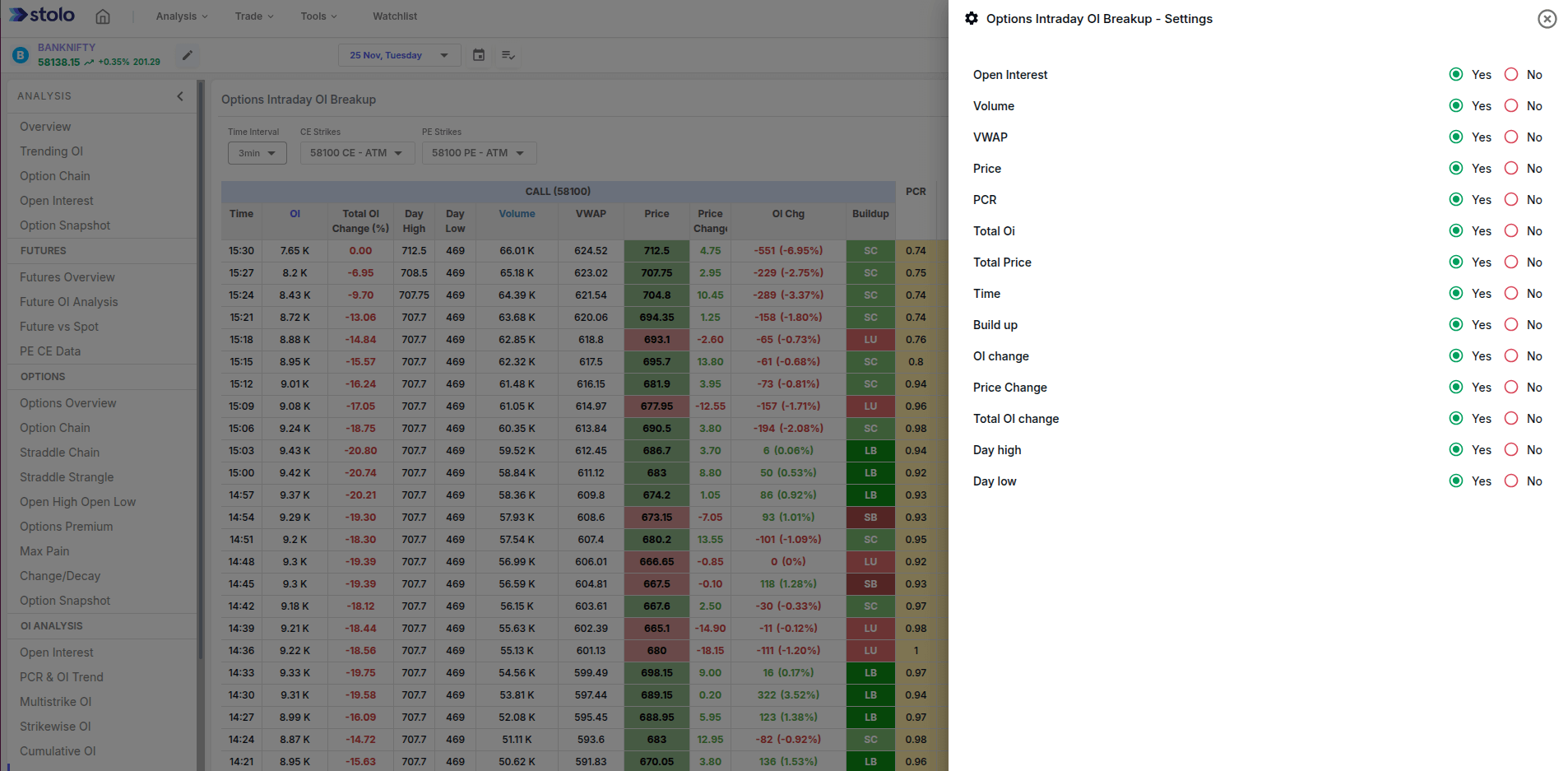
For every time bucket, on both the call and the put side of your chosen strikes:
- Time, OI, OI change, total OI change percent
- Price, price change, day high, day low
- Volume, VWAP
- Buildup: long buildup, short buildup, long unwinding, short covering
Between the two sides, per bucket: PCR, total OI, total premium.
Key terms explained
| Term | What it means |
|---|---|
| Time bucket | A slice of the session, its size set by the interval control. |
| OI change | The move in open interest during that bucket. |
| Total OI change percent | The bucket's OI change as a percentage of the day's total. |
| VWAP | Volume-weighted average price of the option for that bucket. |
| Buildup | The price-and-OI combination label for the bucket. |
| PCR (per bucket) | Put OI divided by call OI at that point in the session. |
A worked example
NIFTY expiry day. You set the call strike to 22,100 and the put strike to 22,000, bucket size 15 minutes.
- 09:15 to 09:30: 22,100 CE shows a large OI addition, price down. Short buildup. Call writers set up early.
- 10:00 to 12:00: small, choppy OI changes on both sides, price rangebound near 22,050.
- 13:00 to 13:15: 22,100 CE OI jumps again, price ticks down, VWAP on the call rising. Writers are adding into the level with conviction.
- 14:30 to 15:00: both sides show OI unwinding as positions square off into the close.
The read: the 22,100 resistance was set early and reinforced at 13:00, so a short bias around 22,100 held all day. A trader selling the 22,100 call had the best entry in that 13:00 bucket when the fresh writing confirmed the level.
How to use it in Stolo
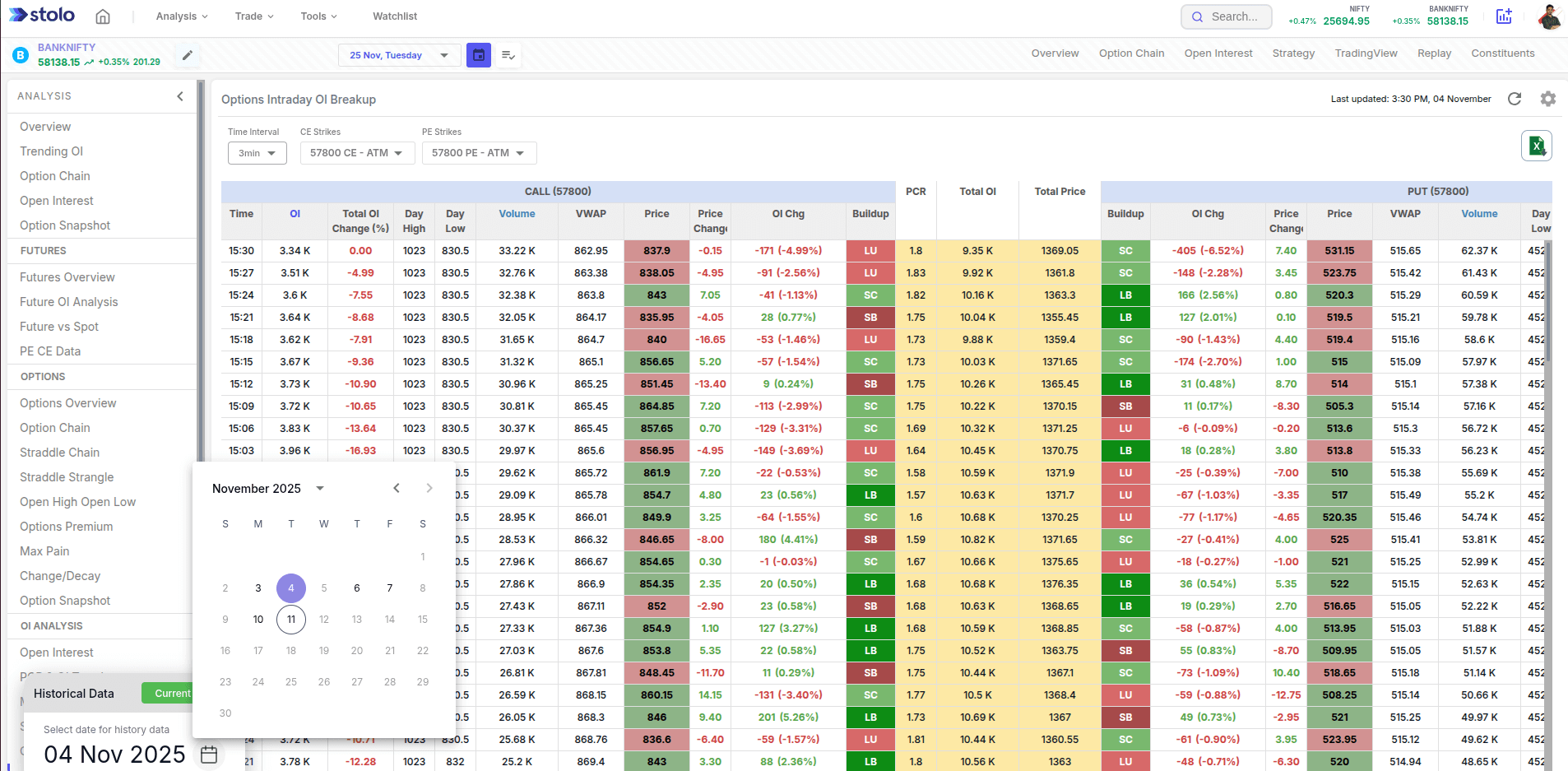
- Open Analysis, then Options, then Options Intraday OI Breakup.
- Choose the instrument and expiry.
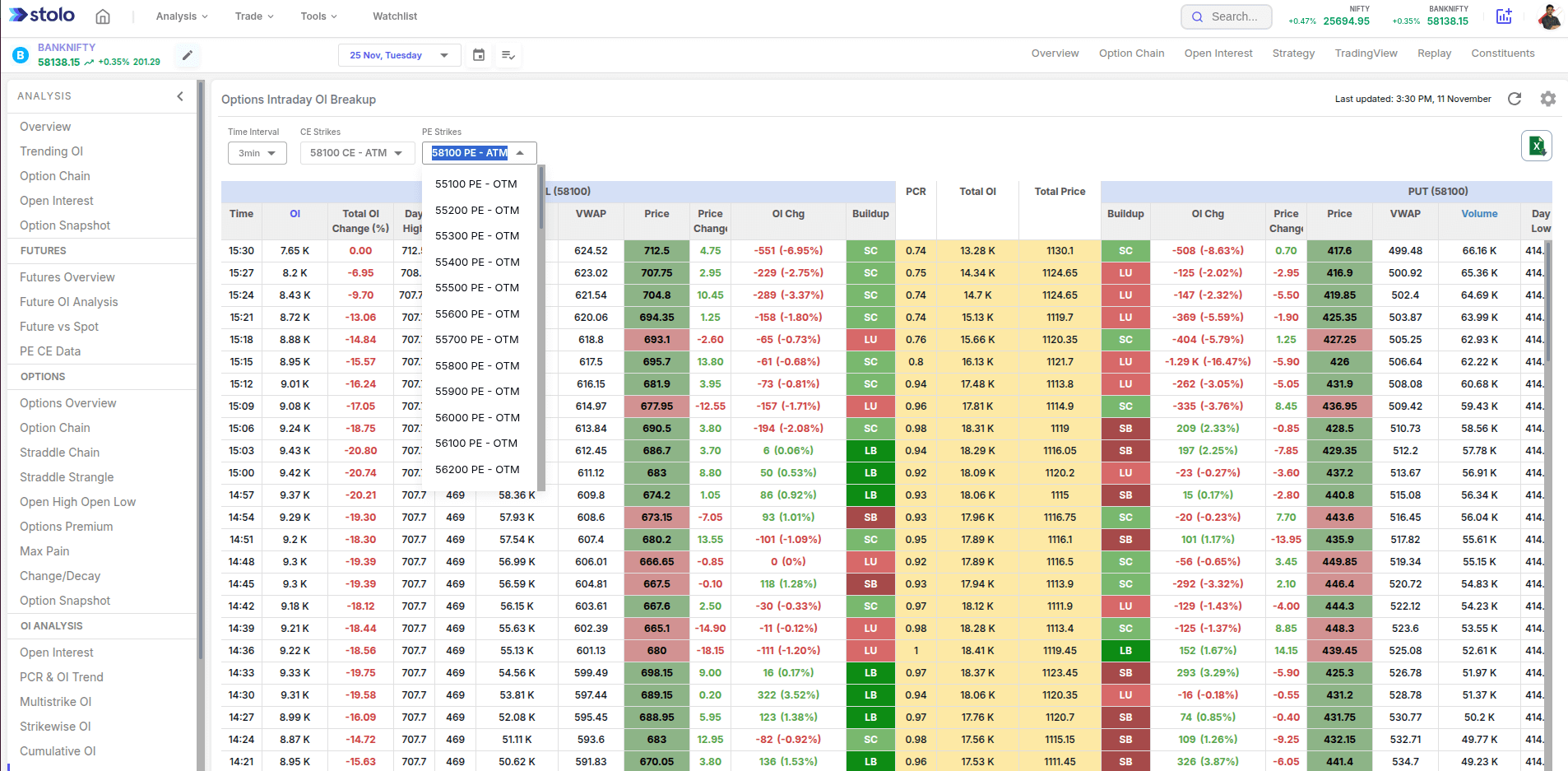
- Set the call strike and put strike you want to track.
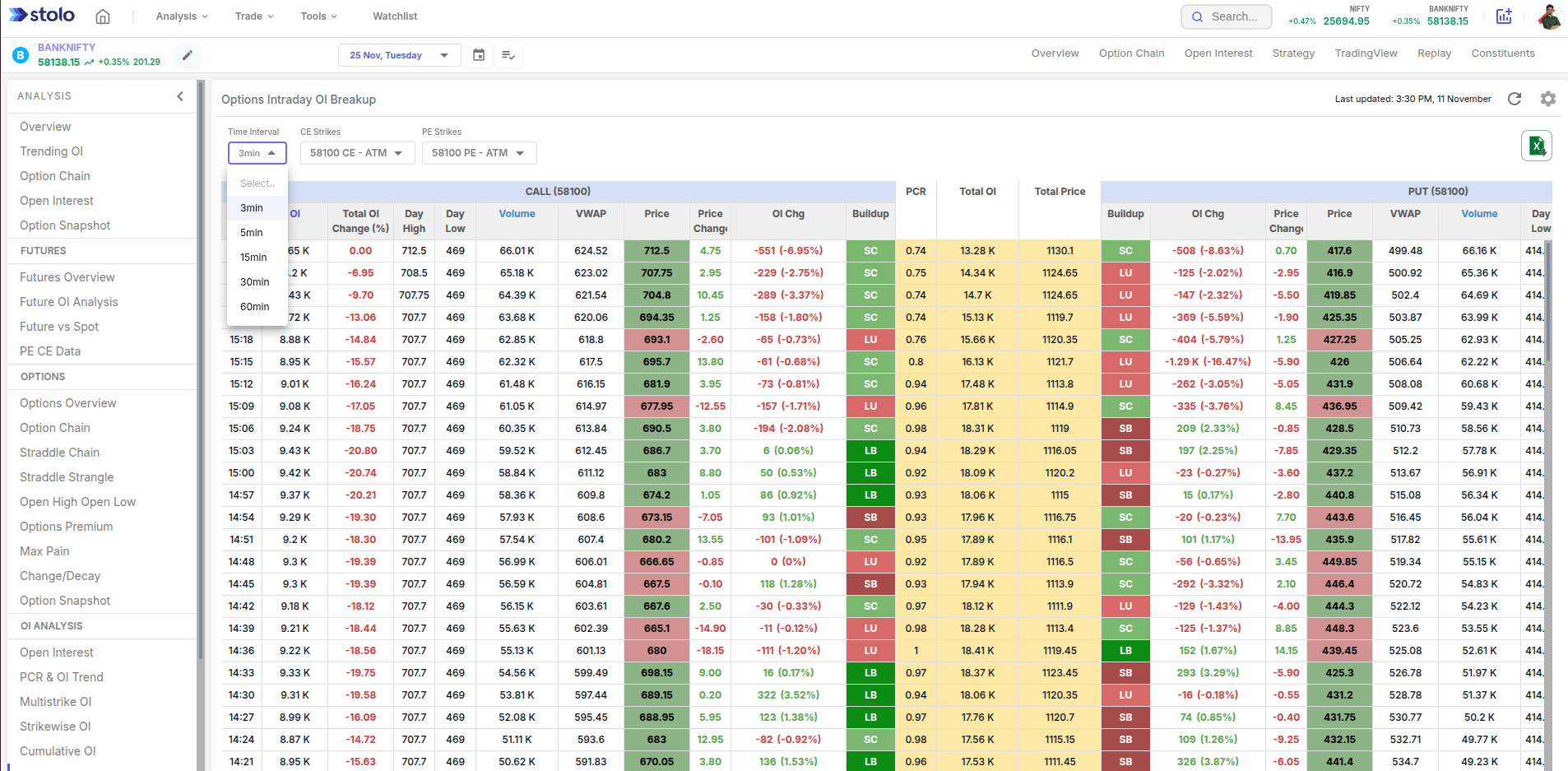
- Set the bucket size.
- Read down the buildup column for each side, and note which buckets carried the biggest OI change.
- Check price change and VWAP alongside to judge whether the writers or the buyers were driving that bucket. Load a past date to study a previous expiry hour by hour.
The most informative buckets are the first 30 minutes and the hour before a scheduled event or the expiry close. Zoom the bucket size down for those windows and back up for the rest of the day.
How traders use it
- Entry timing. Enter a fade or a trend trade in the bucket where fresh, aggressive buildup confirms the level.
- Positioning character. Early-morning buildup on a gap is treated with more suspicion than steady afternoon buildup.
- Expiry mechanics. The last-hour unwinding buckets show squaring off, not new views.
- Divergence spotting. A bucket where price moved hard but OI barely changed is a low-conviction move likely to retrace.
Live mode and history mode
Live mode fills the table bucket by bucket as the session runs. History mode rebuilds it for a past date, which is the cleanest way to study how a given expiry or event day developed.
Frequently asked questions
What is the intraday OI breakup?
What columns does the intraday OI breakup show?
Why does timing of OI change matter?
What is the buildup column?
Can I choose which strikes to analyse?
Can I change the bucket size?
Does this work for stock options?
Can I load the breakup for a past day?
How do I use VWAP in this table?
Which plan includes the intraday OI breakup?
See exactly when the positioning happened
Open Stolo's Options Intraday OI Breakup for OI change, price, volume and buildup per time bucket on any F&O instrument.
Start with a Flexi Trial from ₹199