Option Premium Change and Decay Analysis
An option's price moves for two reasons: the underlying moved, or time passed. Stolo's change and decay view separates the two. The change view shows the full intraday move in the premium; the decay view isolates the erosion from time and volatility cooling. Knowing which one is driving your position tells you whether to hold it or close it.
The problem it solves
You are long a call and the premium is down 20 points. Is that because NIFTY dropped, or because it is 2 PM on expiry day and the option is bleeding theta on a flat market? The first means your trade thesis is wrong and you should exit. The second means you just ran out of time and the lesson is about entry timing. The premium number alone does not tell you; this view does.
The concept
- Premium is intrinsic plus time value. Only time value decays.
- Theta is the decay rate. It is largest at the money and accelerates into expiry.
- A flat market still costs a buyer money. Even with no move, a long option loses its theta every day.
- Volatility can offset or add to decay. Rising IV inflates premium and masks decay; falling IV compounds it.
Key terms explained
| Term | What it means |
|---|---|
| Premium change | The total move in the option price over the period. |
| Premium decay | The part of that move due to time and volatility, not the underlying. |
| Theta | The daily loss in option value from time passing. |
| Time value | The non-intrinsic part of the premium, the only part that decays. |
| Change view | The chart showing the full intraday premium move. |
| Decay view | The chart isolating the erosion. |
A worked example
It is NIFTY expiry day. You are long the 22,000 CE, bought at 90 in the morning when NIFTY was 21,990.
- By 1 PM NIFTY is back at 21,990, exactly where you bought, but the 22,000 CE is now 55.
- The change view shows the premium down 35 points on the day.
- The decay view shows that with the underlying flat, nearly all 35 points is decay: the option has lost more than a third of its value to time alone in half a session.
The read: your directional call was neutral, but the trade still lost because you bought a same-day-expiry option and paid the theta. A seller of that call, meanwhile, has captured the 35 points as pure decay.
How to use it in Stolo
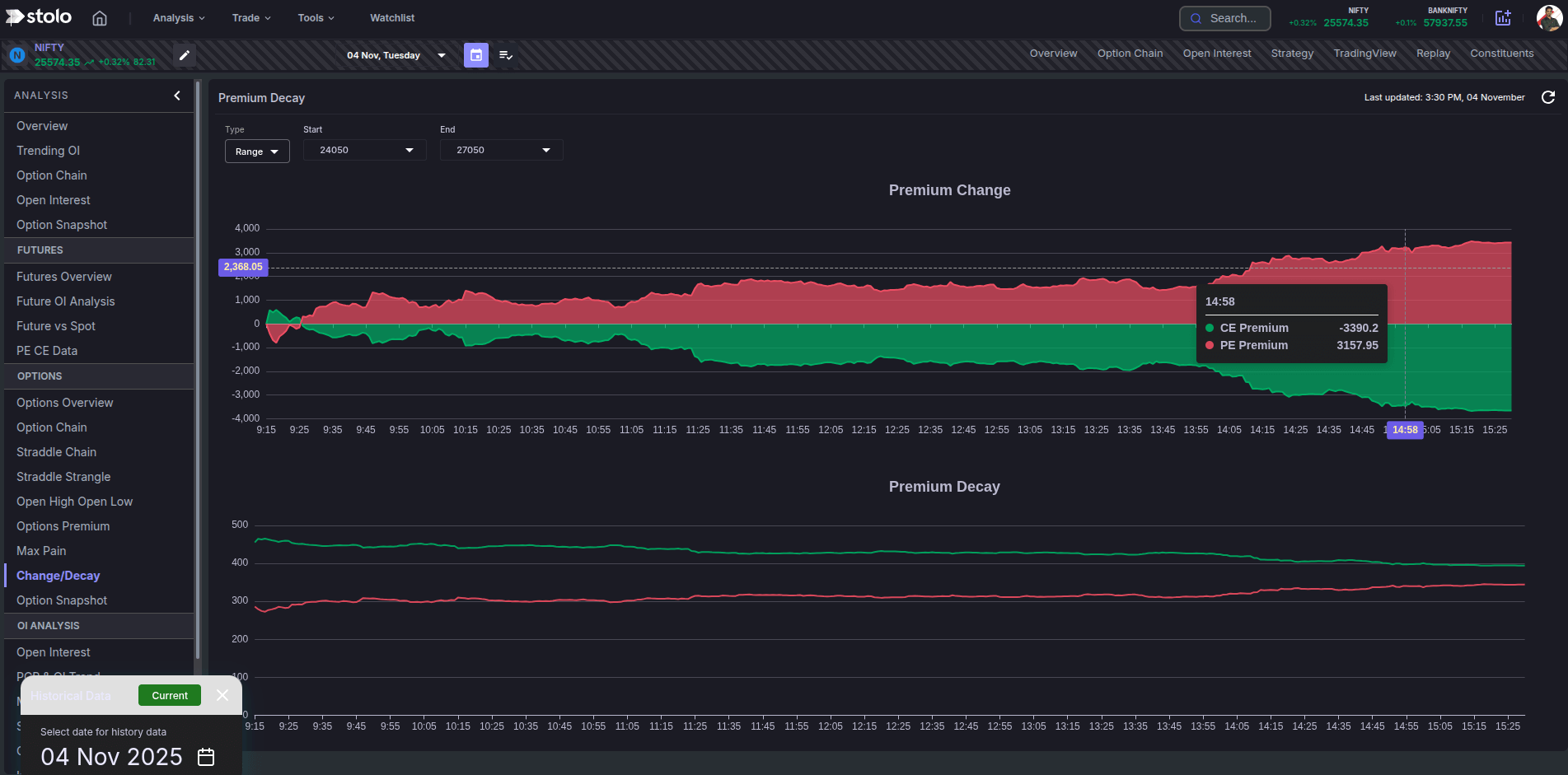
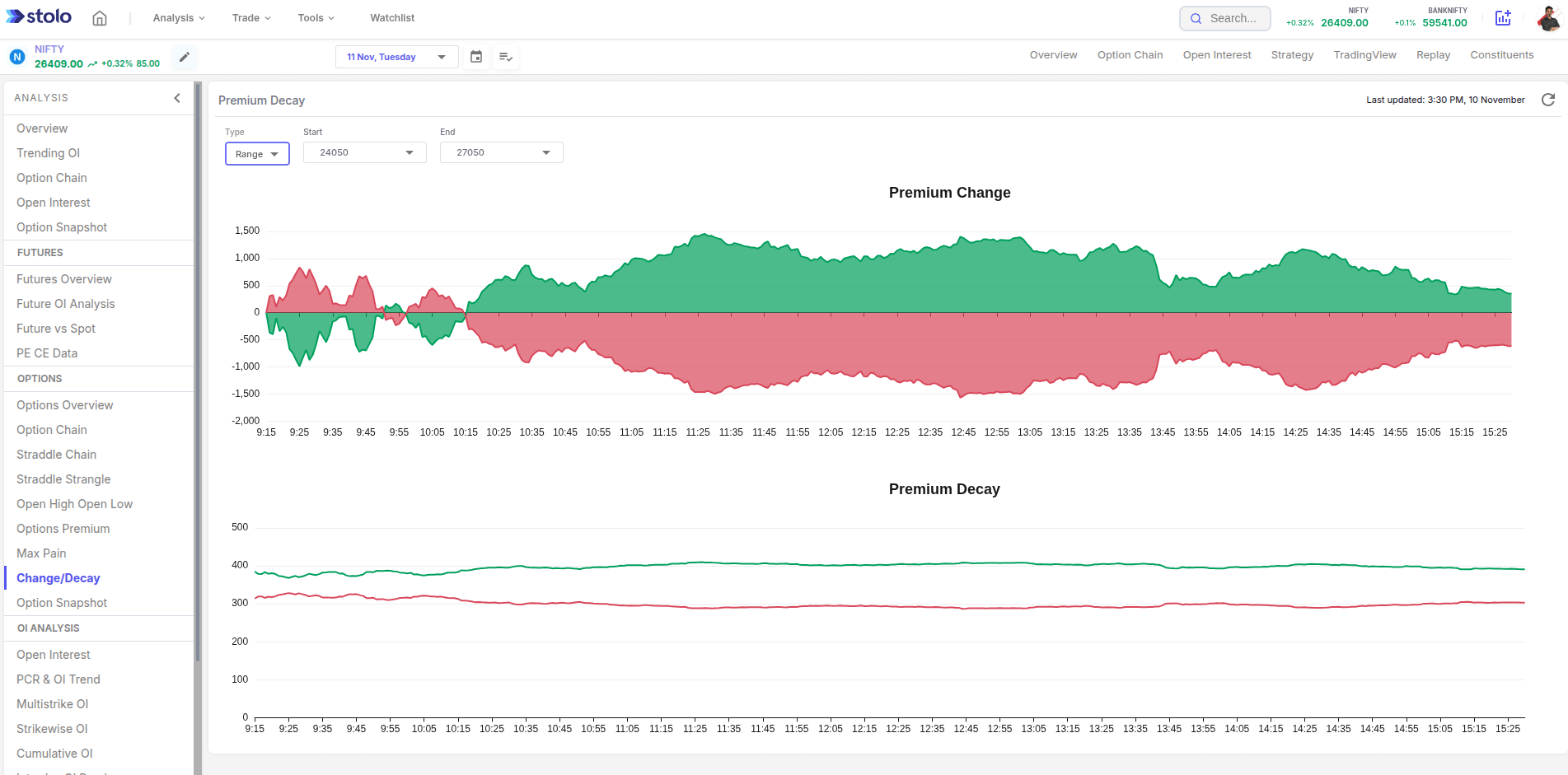
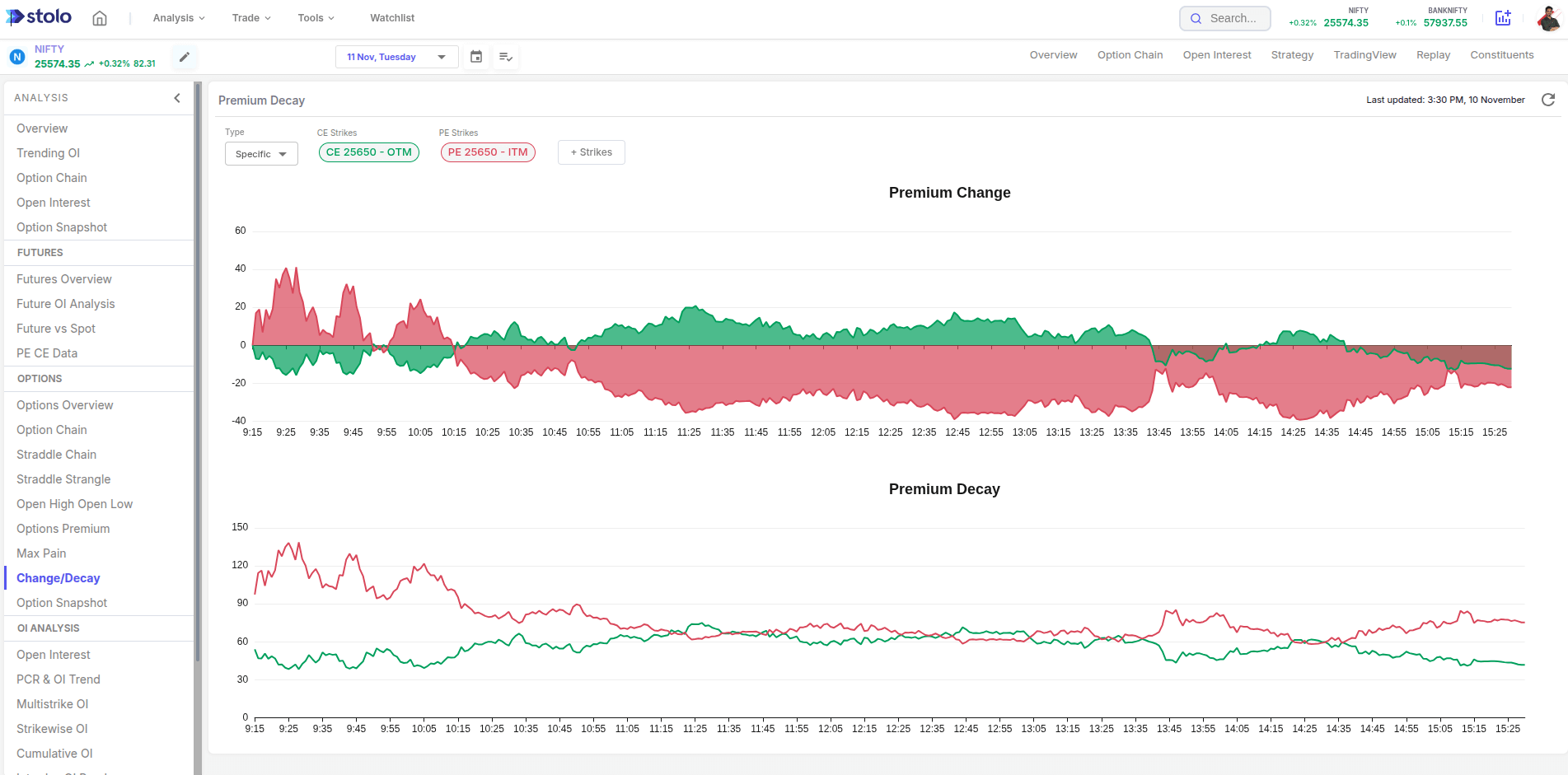
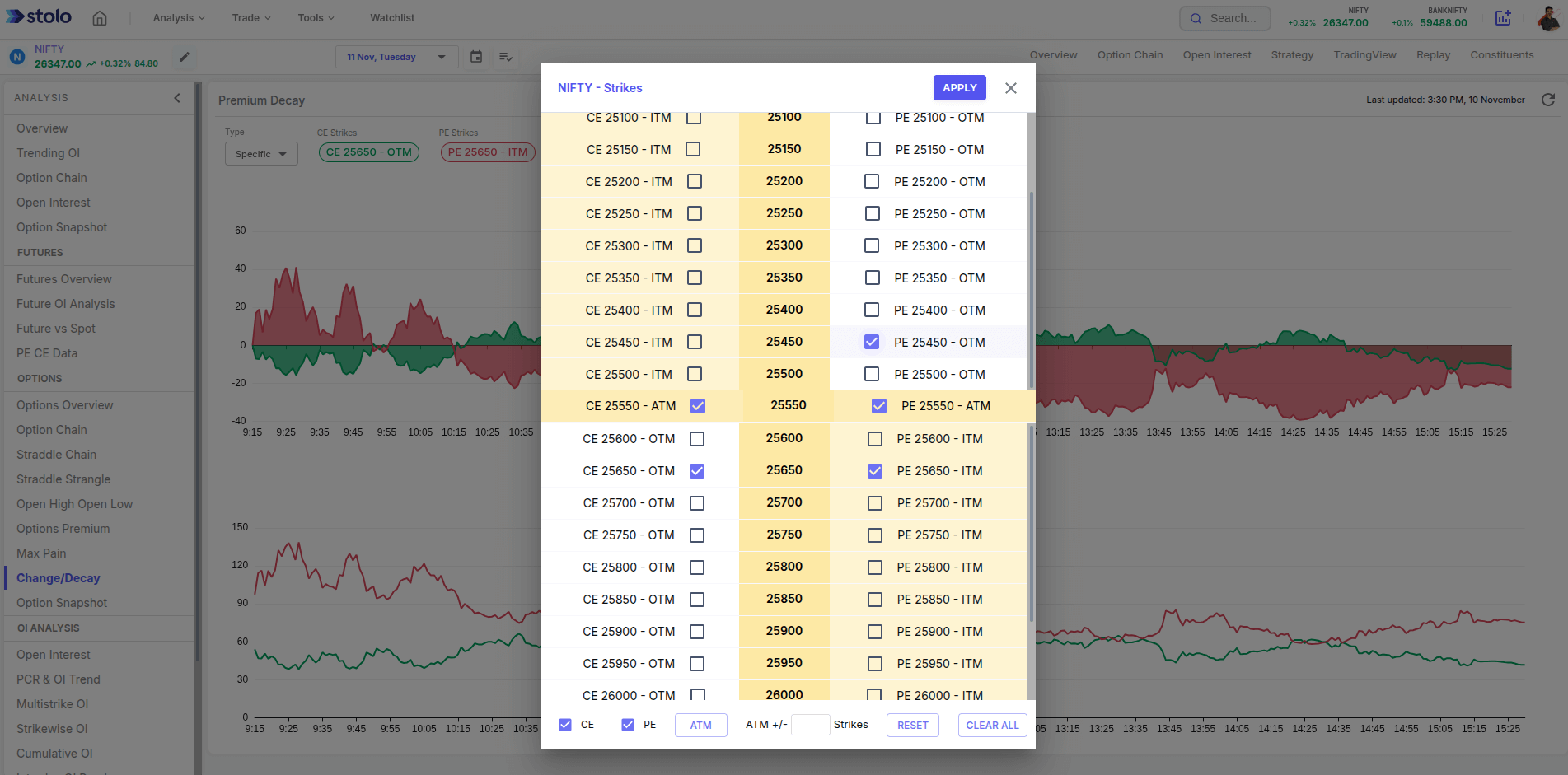
- Open Analysis, then Options, then Change / Decay.
- Choose the instrument and expiry.
- Choose selected strikes to compare specific call and put pairs, or a range of strikes for the pattern across a band.
- Read the change view for the full move, then the decay view to see how much of it is erosion.
- Hover the chart for the values at any point.
- Switch expiries to compare weekly and monthly decay, or load a past date.
If you buy options, check the decay view before entering a same-day or next-day expiry. The theta you will pay by your planned exit time is often larger than the move you are expecting.
How traders use it
- Hold-or-exit decision. A long option down on decay alone, with the thesis intact, is a hold; down because the underlying moved is an exit.
- Seller confirmation. Watch decay run on the strikes you have written, and note when it slows.
- Entry timing for buyers. Avoid strikes and expiries where decay by your exit time swamps the expected move.
- Straddle management. With the call and put overlaid, see which leg is decaying and which is carrying the position.
Live mode and history mode
Live mode updates the change and decay lines through the session. History mode loads a past date so you can study how a strike decayed on a previous expiry and calibrate what to expect.
Frequently asked questions
What is the difference between premium change and premium decay?
What is theta?
Why do I need to separate change from decay?
How does the decay view help option sellers?
Can I analyse a single strike or a range?
Does this show calls and puts together?
Which strikes decay the fastest?
Does the change and decay view update live?
Can I see this for a future expiry or a past date?
Which plan includes the change and decay view?
Know why the premium moved
Open Stolo's Change and Decay view to separate directional moves from time decay across option strikes, live or on any past date.
Start with a Flexi Trial from ₹199